how can we help?
Get answers to common questions on all things Teamfluence™
Getting Started with Workflows: Your First Automation
Last Updated:
Friday, February 20, 2026
Tutorial • 15 minutes • Prerequisites: Active workspace with leads
What you'll learn
By the end of this tutorial, you'll have created your first workflow that automatically qualifies leads and routes them based on their connection status. This hands-on guide walks you through the essential concepts of Teamfluence workflows while building something immediately useful.
What you'll build
A workflow that:
Detects new leads from profile visits
Checks if they're ICP matches
Routes connected leads to Slack for immediate follow-up
Adds unconnected ICP matches to a networking campaign
Before you begin
You'll need:
A Teamfluence workspace with at least one connected LinkedIn profile
The Teamfluence Chrome extension installed and active
Access to the Workflows feature in your sidebar
Optional: Slack connected for notifications
Pro tip: Workflows only trigger on new leads that come in after activation. Historical data won't be processed retroactively. Once your workflow is live, new profile visits will start flowing through immediately.
Step 1: Navigate to Workflows
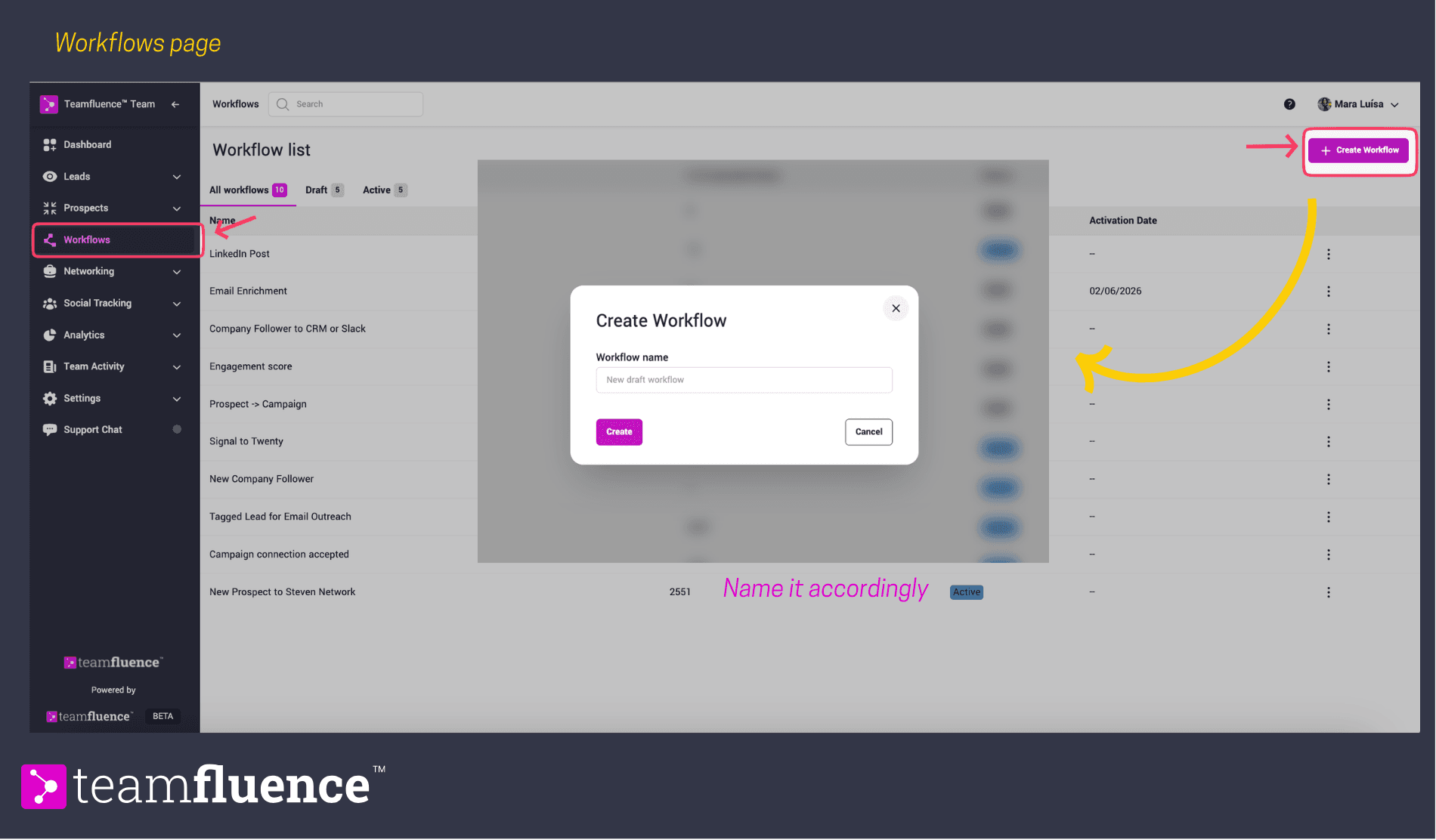
Open your Teamfluence workspace
Click Workflows in the left sidebar
Click Create Workflow in the top right
You'll see a blank canvas with a prompt to select a trigger. This is where every workflow begins.
Step 2: Choose your trigger
Triggers are the "when" of your workflow—they define what event kicks everything off.
Click Select trigger
Choose New Profile Visit
Click Next step
Why this trigger? Profile visits are high-intent signals. Someone took the time to look at a LinkedIn profile—that's worth acting on.
Available triggers include:
New Lead (any engagement type)
New Prospect (qualified leads)
Team Member Post Reaction
Team Member Post Comment
Profile Visit
New Connection
Company Page Follow
📸 Recommended visual: Annotated screenshot showing the trigger selection menu with "New Profile Visit" highlighted
Step 3: Add your first filter - ICP Match
Now we'll add a filter to sort high-quality leads from noise. Filters are the "if" statements of workflows.
Click Next step under your trigger
Select Filter
Choose ICP Match
Select True (we only want matches)
What happens here: Only profile visits from people who match your ICP criteria will continue through the workflow. Non-matches are automatically filtered out.
💡 Note: If you haven't configured your ICP yet, see Setting Up Your ICP first.
📸 Recommended visual: Step-by-step screenshot sequence showing:
The "Add step" menu
Filter selection
ICP Match configuration
True/False branching
Step 4: Add a second filter - Connection status
Let's split the workflow based on whether you're already connected with the lead.
Click Next step below the ICP Match filter
Select Filter
Choose Team Member Connected
Select your profile from the dropdown
This creates two branches: True and False
Why this matters: Connected leads can be messaged directly on LinkedIn. Unconnected leads need connection requests first. Different connection statuses require different actions.
📸 Recommended visual: Screenshot showing the branching structure with True/False paths clearly labeled
Step 5: Configure the "True" branch - Send to Slack
For leads you're already connected with, send an immediate notification to Slack.
On the True branch:
Click Next step
Select Action
Choose Push to Slack
Select your Slack channel (e.g., "#teamfluence-alerts")
Check "Allow Slack users to qualify leads" if you want team members to promote leads to prospects directly from Slack
What this does: When an ICP-matched profile visitor who's already connected views your profile, your team gets an instant Slack alert with their details.
💡 Pro tip: Create a dedicated Slack channel for workflow notifications to keep your main channels clean.
📸 Recommended visual: Screenshot of the Slack action configuration panel
Step 6: Configure the "False" branch - Add to Campaign
For unconnected ICP matches, let's automatically add them to a networking campaign.
On the False branch:
Click Next step
Select Action
Choose Add to Networking Campaign
Select an existing campaign from the dropdown (or create one by clicking "Create new campaign")
What this does: Unconnected leads who match your ICP are automatically added to a campaign that will send connection requests over time.
⚠️ Important: Before selecting a campaign, we recommend creating a dedicated campaign specifically for workflow-routed leads. This allows you to:
Track conversion rates for this specific audience
Customize messaging for profile visitors vs. other lead sources
Adjust sending rates independently from other campaigns
To learn how campaigns work and how to create one, see How to Set Up Networking Campaigns. Campaigns send connection invites gradually (5-10 per day by default) to respect LinkedIn's limits and mimic natural behavior.
📸 Recommended visual: Screenshot showing the Add to Networking Campaign action with campaign dropdown
Step 7: Name and activate your workflow
Click the workflow title at the top (default: "Untitled Workflow")
Rename it to something descriptive: "Profile Visits → ICP → Route by Connection"
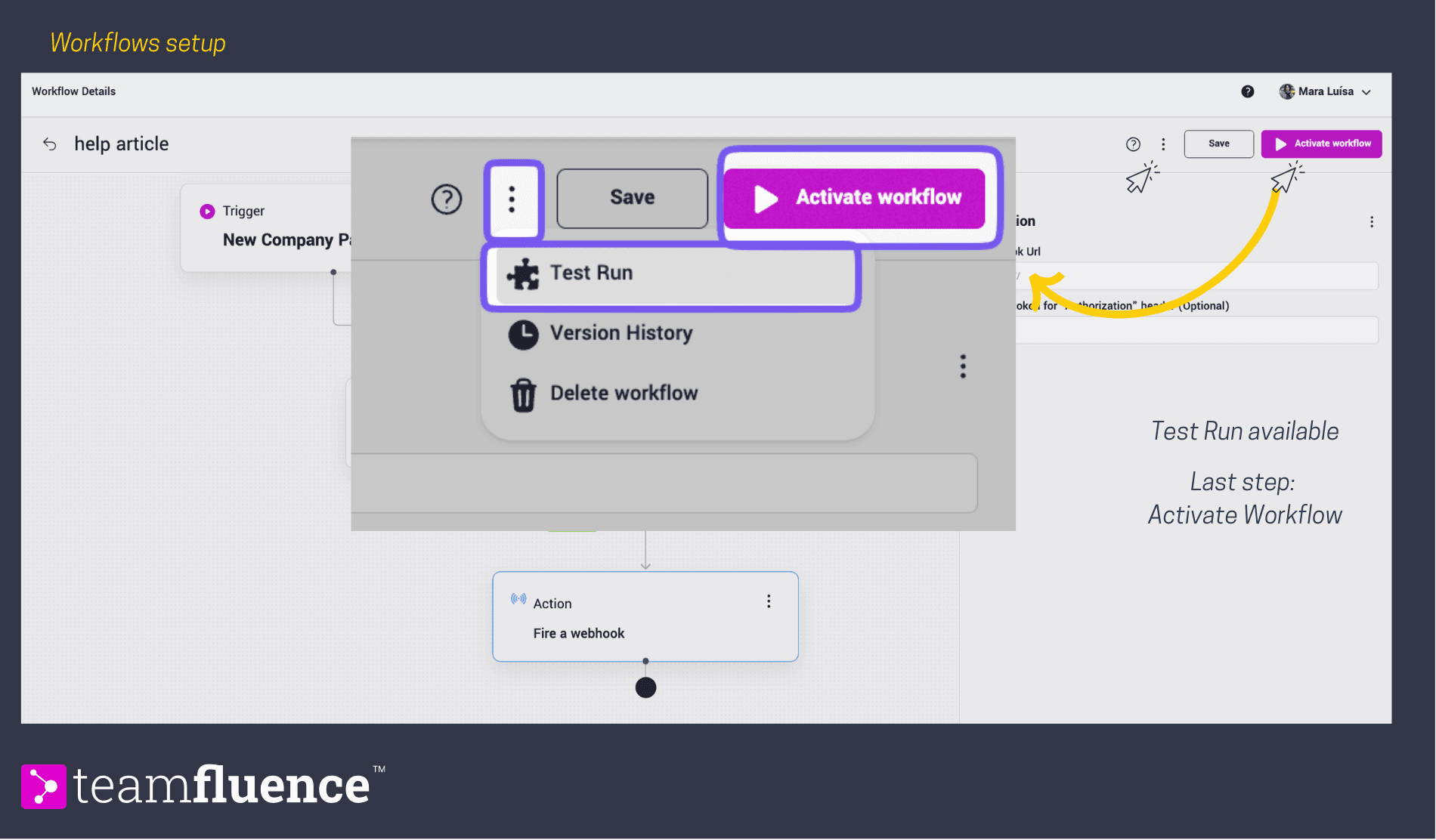
Toggle the switch to Active
Naming tips: Use descriptive names that explain the trigger → filter → action flow. You'll thank yourself when you have multiple workflows running.
Step 8: Test your workflow
Before relying on your workflow, test it with real data.
Click the three-dot menu (⋮) on any step
Select Test run
Review the test results to confirm the workflow behaves as expected
What to check:
Are leads being filtered correctly?
Do Slack notifications appear in the right channel?
Are leads being added to the correct campaign?
You did it!
Your first workflow is now live and automating lead qualification and routing. As profile visits come in, your workflow will:
✅ Identify ICP matches automatically
✅ Send immediate Slack alerts for connected leads
✅ Queue networking campaigns for unconnected leads
What happens next: Your workflow runs automatically in the background. Check back in 24-48 hours to see leads flowing through the system.
Next steps
Now that you've built your first workflow, explore these tutorials:
Advanced Filtering: Building Complex Logic - Combine multiple conditions with multiple filters and TRUE/FALSE branches
Webhook Integration: Send Leads to Your CRM - Push qualified leads to HubSpot, Salesforce, or custom endpoints
Multi-Step Workflows: Building Lead Scoring Systems - Create sophisticated qualification logic
Want inspiration? LinkedIn - The Essentials
Troubleshooting
My workflow isn't triggering
Verify the Chrome extension is active and logged in
Check that your LinkedIn profile is connected in Settings
Check if there’s any errors in the workflow setup
Check the Run information
Confirm the workflow toggle is set to Active
Leads aren't matching my ICP
Review your ICP configuration
Test your ICP settings with known good leads
Consider adjusting your qualification criteria
Slack notifications aren't appearing
Confirm Slack is connected in Settings
Verify the selected channel exists and the Teamfluence app is invited
Check the channel permissions
Networking campaign isn't sending invites
Verify your daily invite limits aren't exceeded
Confirm the campaign is Active
Check that the LinkedIn profile has sufficient connection quota remaining
Video walkthrough
Related documentation
Workflow Signals/Triggers/Actions Reference - Complete list of available action
Networking Campaigns - Deep dive into automated connection requests
Teamfluence OÜ
Tornimäe tn 5
Harju maakond
Kesklinna linnaosa
10145 Tallinn
Estonia
mail: hello@teamfluence.com
Registry Code: 17381325
VAT: EE102936218
stay in the loop

Hey, I'm Steven, the founder here. 👋🏻
I run a personal mailing list where I share what we're learning from our users and sales leaders about what actually works on LinkedIn.
Only the good stuff, and only when it matters.
A low-key, occasional mailing list from our founder.
No pitching, no selling, just the learnings. You can unsubscribe at any time. We never share your data and we hate spam.
ask ai about us
additional resources
Check our knowledge base and get help
See what we have planned
Tell us what you are missing
This is how we handle your data
We play by these rules
How we work as your data processor