


Your Target Account List Is Live. Now What?
You uploaded 200 accounts. Maybe 500. You spent weeks building the list: the right industries, the right company sizes, the right revenue bands. Your ICP criteria are dialed in.
Then you wait.
Signals start coming in. A profile visit from someone at a target account. A post reaction from another. A new connection request from a third.
And for most teams, that's where the process breaks.
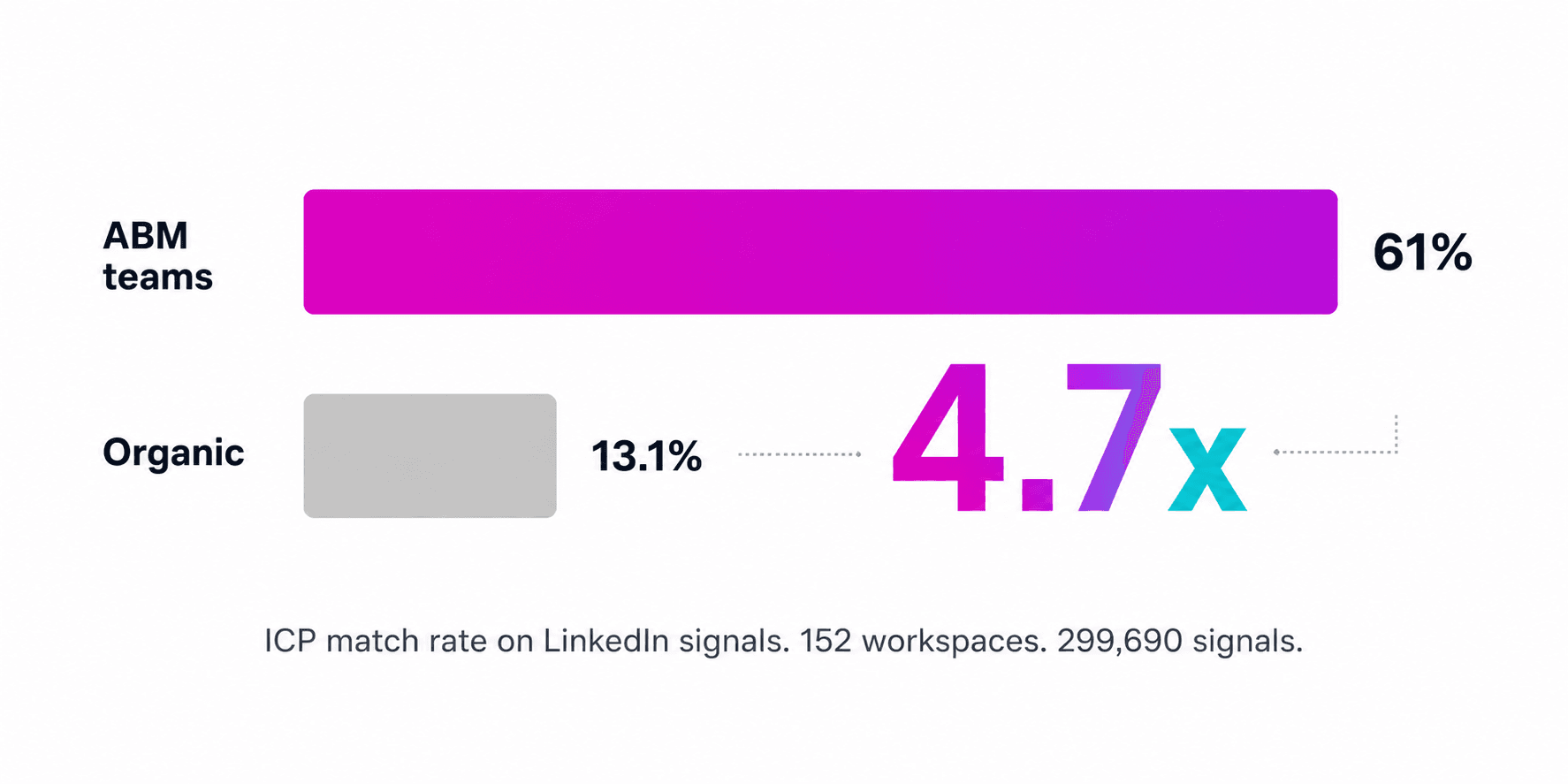
Not because the signals aren't valuable. They are. ABM-focused teams see a 61% ICP match rate on their linkedin signals. Teams without target accounts sit at 13.1%. That's a 4.7x difference, measured across 150+ sample workspaces and almost 300,000 signals.
The target account list works. The problem is what happens after the signals arrive.
The Single-Touch Problem
Here's a number that should bother every ABM team: 88.6% of target accounts have only one person engaging.
One profile visit. One post reaction. One follow. One data point.
And 45.6% of ICP-matched leads interact exactly once.
That means nearly half your qualified signals from target accounts show up as a single touchpoint, easy to miss in a notification feed, easy to ignore as "just a profile view," easy to lose in the gap between linkedin's interface and your CRM.
For context, here's how engagement distributes across all accounts in our dataset:
| Engagement level | % of accounts |
|---|---|
| 1 person engaging | 88.6% |
| 2 people | 7% |
| 3-5 people | 3.2% |
| 6+ people | 1.1% |
When you see an account with 3+ people engaging, that's buying committee activity. But you only see it if you're tracking signals at the account level, not the individual level.
Why Notification-Based Tracking Fails
Most linkedin users "manage" their signals by checking notifications. Scroll, glance, maybe remember to follow up.
This fails at ABM for three reasons.
1. Signals split across the team. Your prospect likes a post from your Head of Sales on Monday. They view your AE's profile on Wednesday. They follow your company page on Friday. Three signals from one target account in one week. Three different team members' notification feeds. Nobody connects the dots.
2. LinkedIn doesn't show you what matters. You get "142 people viewed your post." You don't get "3 of them are from Acme Corp, all VP-level, all matching your ICP, and this is the second week they've engaged." That account-level context is where the pipeline lives. The platform doesn't surface it.
3. Speed matters and notifications are slow. Our data shows the response window for social signals is 24-48 hours. After that, intent decays. When a signal sits in a notification feed for three days before someone notices, it's already cold.
What High-Performing ABM Teams Do Differently
The teams converting target account signals into pipeline share an operational pattern. It's not complicated. But it does require moving beyond notifications.
1. Capture signals across the full team
A single rep tracking their own profile catches maybe 20-30% of relevant signals. The rest happen on other team members' profiles, on company page engagement, on post reactions from people they're not connected with.
Team-wide signal capture changes the math. You see the full picture per account instead of fragmented views per rep.
2. Stack signals per account, not per person
Individual signals are weak. A profile visit from one person at a target account is interesting but not actionable by itself.
Three people from the same account engaging in the same week? That's an account-level buying signal. But you only see it if your system aggregates signals by company, not by individual.
The account coverage data makes this clear:
| ICP contact engagement | % of accounts |
|---|---|
| 1 ICP contact | 86.1% |
| 2 ICP contacts | 8.5% |
| 3-5 ICP contacts | 4% |
| 6+ ICP contacts | 1.3% |
The 13.9% of accounts with multiple ICP contacts engaging? Those are your highest-intent accounts. They get lost when you track signals at the person level.
3. Prioritize by signal type
Not all signals carry the same weight. From our benchmark data:
| Signal type | ICP match rate |
|---|---|
| Campaign connections | 41.1% |
| Company post comments | 31.4% |
| Company post reactions | 22.6% |
| New connections | 22.0% |
| Profile followers | 19.9% |
| Post comments | 10.1% |
| Post reactions | 9.5% |
A campaign connection from a target account is a different signal than a post reaction. Your response should be different too.
Campaign connections and company-level engagement from target accounts are the strongest indicators. Post reactions from target accounts still matter, but they sit lower on the priority stack.
4. Act within 48 hours
The 24-48 hour window isn't arbitrary. After two days, the person who visited your profile has visited ten others. The connection request that felt warm on Monday is cold by Thursday.
For target accounts, this is especially critical. You already know these are companies worth pursuing. The signal is telling you when to act. Letting it decay is throwing away the timing advantage ABM gives you.
5. Route signals into workflows, not spreadsheets
The manual version of this: someone checks notifications, logs signals in a spreadsheet, flags accounts that are heating up, and messages the rep who owns that account.
It works at 20 target accounts. At 200, it breaks. At 500, it's fiction.
The operational version: signals get captured automatically, qualified against ICP, aggregated at the account level, and routed to the right person or tool. A webhook fires to your CRM. A Slack notification hits the account owner. An enrichment task pulls the contact's email. A connection campaign queues up.
The system does the capturing and routing. Reps do the selling.
When to Build vs. When to Bring In Help
Some teams build this internally. They have the GTM operations experience, the technical bandwidth to set up signal capture and workflows, and the time to iterate on the process.
Others don't. They have the target account list, strong content, and a sales team ready to act. But they don't have someone to build and operate the signal infrastructure.
We've seen both work.
A healthcare SaaS company had a focused target account list and consistent linkedin content. But no one was watching the signals. No system to capture who was engaging from which accounts, no workflow to route those signals to reps. They brought in operational support to build and run the signal layer. Within 60 days, target account engagement went from invisible to a top pipeline source.
A B2B company in a similar spot: right list, right content, no process. The signals were there the whole time. They just needed the infrastructure to catch them.
The pattern repeats. The target account list is strategy. The signal capture and routing is operations. Most teams are strong on one, weak on the other.
If you have the internal team and bandwidth, build the system. If you don't, bringing in a GTM operations partner to run the signal side will get you to pipeline faster than trying to hire and train for it.
The Playbook: Target Account Signal Management
Here's the operational checklist:
Setup (do once)
- Upload your target account list with ICP criteria defined
- Enable team-wide signal capture across all rep profiles
- Set up account-level signal aggregation
- Configure workflows: signal > ICP qualification > routing
Weekly operations
- Review accounts with multiple signals in the past 7 days
- Prioritize accounts where 2+ people have engaged (buying committee signal)
- Check for campaign connections from target accounts (highest-quality signal at 41.1% ICP match)
- Ensure all high-priority signals were acted on within 48 hours
Monthly review
- Total signals from target accounts vs. organic
- ICP match rate on target account signals (benchmark: 61%)
- Accounts that moved from "one signal" to "multiple signals" (heating up)
- Average response time on target account signals
- Pipeline generated from target account signals vs. other sources
The Numbers That Matter
ABM on linkedin works. The data is unambiguous: 61% ICP match vs. 13.1% organic. 4.7x more qualified signal from the same platform activity.
But the list alone doesn't produce pipeline. The signals need to be captured across the team, stacked at the account level, and acted on before intent decays.
Most teams lose the signal in the gap between linkedin's notification feed and their CRM. Close that gap and the target account list delivers what it's supposed to.