GTM Engineer looking for the most complete social signal source?Check out our GTM Unlimited Plans

Teamfluence Pulse
is in closed beta

Join the wait list. We onboard new batches every week.

Please tell us who you are

We want to make sure, the early bird users are getting the most value out of Teamfluence Pulse, so we hand pick the members of each batch.

Please make sure you provide a valid mobile phone number (include your country code!).

We will ask you questions over WhatsApp and iMessage and will send you the access code to your phone.

Sumit N.RevOps & GTM Architect for B2B Product & Services | Turning Chaotic Growth into Predictable Revenue Engines | $10M+ Pipeline Generated | HubSpot · Salesforce · Clay · AI Automation1d

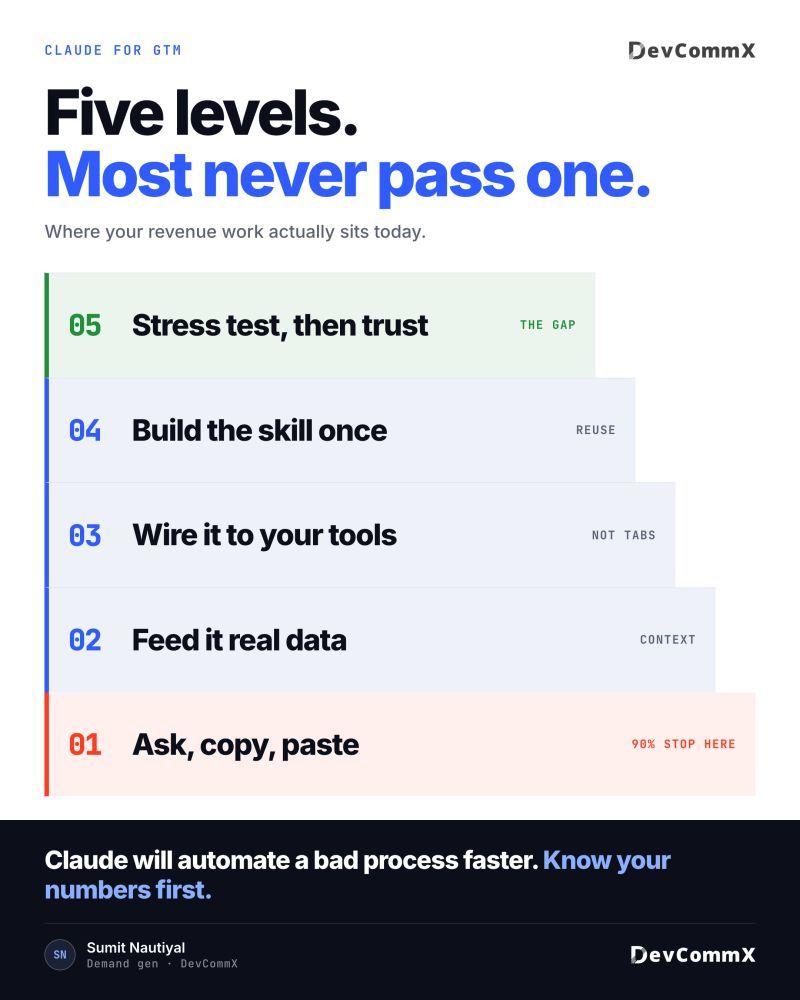
There are 5 levels of using Claude for GTM. Most teams never pass level 1. That's level one. Most never leave it. Here's what the levels actually look like when you're running revenue work through it. Level 1. Ask it questions, copy the answer. This is where 90% of RevOps teams stop. Fine for drafting a subject line. Useless for anything that touches your actual pipeline. Level 2. Feed it your real data, not hypotheticals. Stop asking "write me a cold email." Start feeding it your actual reply rates, your actual ICP, your actual objections from last week's calls. The output changes completely once it has context instead of guesses. Level 3. Wire it into your tools, not your tabs. Once Claude Code can talk to Apollo.io, Instantly.ai, and HeyReach directly, you stop copying data between five browser tabs. You're not asking Claude about your outreach anymore. It's running inside it. Level 4. Build the skill once, reuse it forever. Level 5. Stress test before you trust it. Before Opus 4.7 touched my LinkedIn revenue system, I ran it against edge cases on purpose: bad data, ambiguous replies, conflicting signals. Most people skip this step and find out the hard way when a real prospect gets a broken sequence. Honest caveat: none of this replaces knowing your numbers. Claude will happily automate a bad process faster than you can catch it. The teams that win here already know what "good" looks like before they hand it off. Where's your GTM stack still stuck at level one?

Christian PlascenciaFounder @ Pipeline.tech | Full TAM Coverage GTM3d

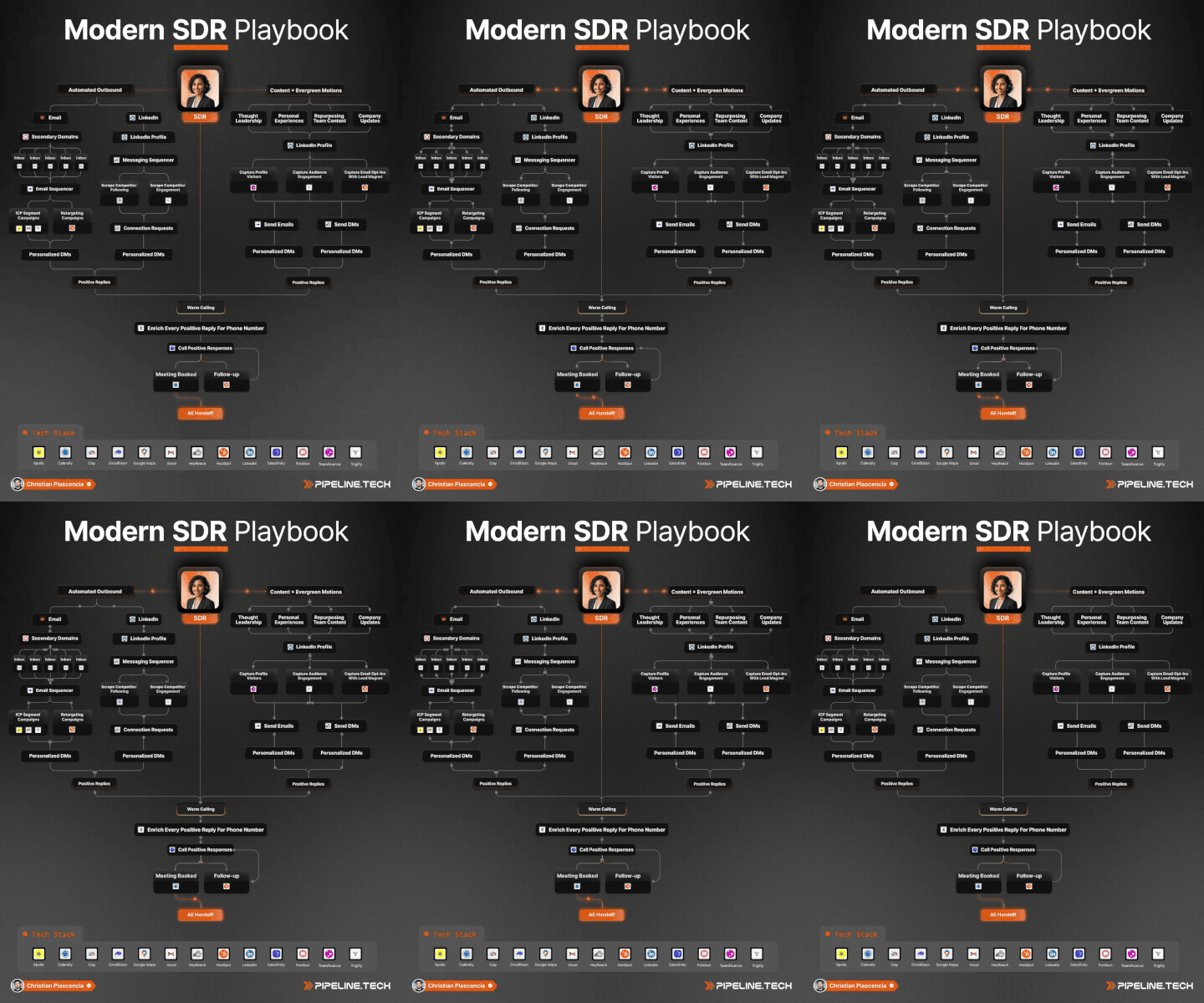
The traditional SDR playbook is dead. 1 modern SDR can now match the output of 10. Here's how the sales landscape has shifted: ❌ Traditional SDR playbook > Manually creating prospect lists > Writing out individual cold emails by hand > Calling only cold outbound leads all day ✅ Modern SDR playbook (AI-enabled) > Vibe-coding full TAM lists with Claude Code & Clay > Sending 1,000s of emails + LinkedIn DMs per day > Posting LinkedIn content to generate personal inbound > Spends more time calling warm leads generated from automated motions vs cold calling The most AI forward B2B sales orgs know this and are 2-5Xing their revenue per rep. Here’s how the brightest B2B orgs are implementing the modern SDR playbook: 𝐓𝐡𝐞 𝐌𝐨𝐝𝐞𝐫𝐧 𝐒𝐃𝐑 𝐏𝐥𝐚𝐲𝐛𝐨𝐨𝐤 There are 3 primary actions the SDR owns: 1. Automated outbound 2. LinkedIn content + evergreen motions 3. Warm calling How each works: 1️⃣ AUTOMATED OUTBOUND SDRs will run cold email + LinkedIn connection campaigns everyday. Instead of manually handpicking leads through Sales Navigator, we’ll use Claude Code to build niche account lists or Clay CLI to build TAM lists connecting enrichment tools such as Prospeo, Icypeas, and GetLeads for maximum coverage. Lists will be added to automatically sequenced campaigns, email personalization will be generated for each lead through Clay, and script variants will be added to the email sequencer for testing. Outbound Tech Stack: ↳ Domains: Porkbun ↳ Inboxes: ScaledMail (Google) ↳ Sequencer: EmailBison ↳ List Building: Clay ↳ Enrichment: Icypeas, Prospeo, GetLeads ↳ Verification: MillionVerifier, BounceBan ↳ Automation: Claude Code 2️⃣ LINKEDIN CONTENT + EVERGREEN MOTIONS SDRs will post content & set up automated workflows to capture engagement. Content to post: - Thought leadership (sales, product, team) - Personal experiences (personal growth, events, stories) - Repurposing team content (educational content) - Company updates (milestones, product changes) SDRs post 3-5 times per week. Engagement will be funneled into Clay using following tech stack: ↳ Trigify.io: scrape personal LinkedIn engagement on posts ↳ Teamfluence: scrape personal profile visitors ↳ Typeform/HubSpot: capture email opt-ins on lead magnets Inside Clay, we’ll qualify all inbound leads with Claygent’s research function. All qualified leads will then be pushed to an automated sequence or warm called. 3️⃣ WARM CALLING SDRs will call all outbound/inbound interested leads within 5 minutes. Speed to lead is ESSENTIAL here, nearly 400% more leads convert when called within 5 minutes of an engagement (cited by Harvard Business Review) The concept is simple: Call The Damn Leads. Meeting book rate will skyrocket. Calling Tech Stack: ↳ Dialer: Salesfinity ↳ Phone # enrichment: Prospeo, TitanX [[[ POST CONTINUED IN COMMENTS ]]]

68 reactions 17 comments
Gilbert KralingerContent ​> GTM systems ​> Sales Pipeline 📈 Revenue Architect & GTM Engineer 🤖 Clay Enterprise Partner3d

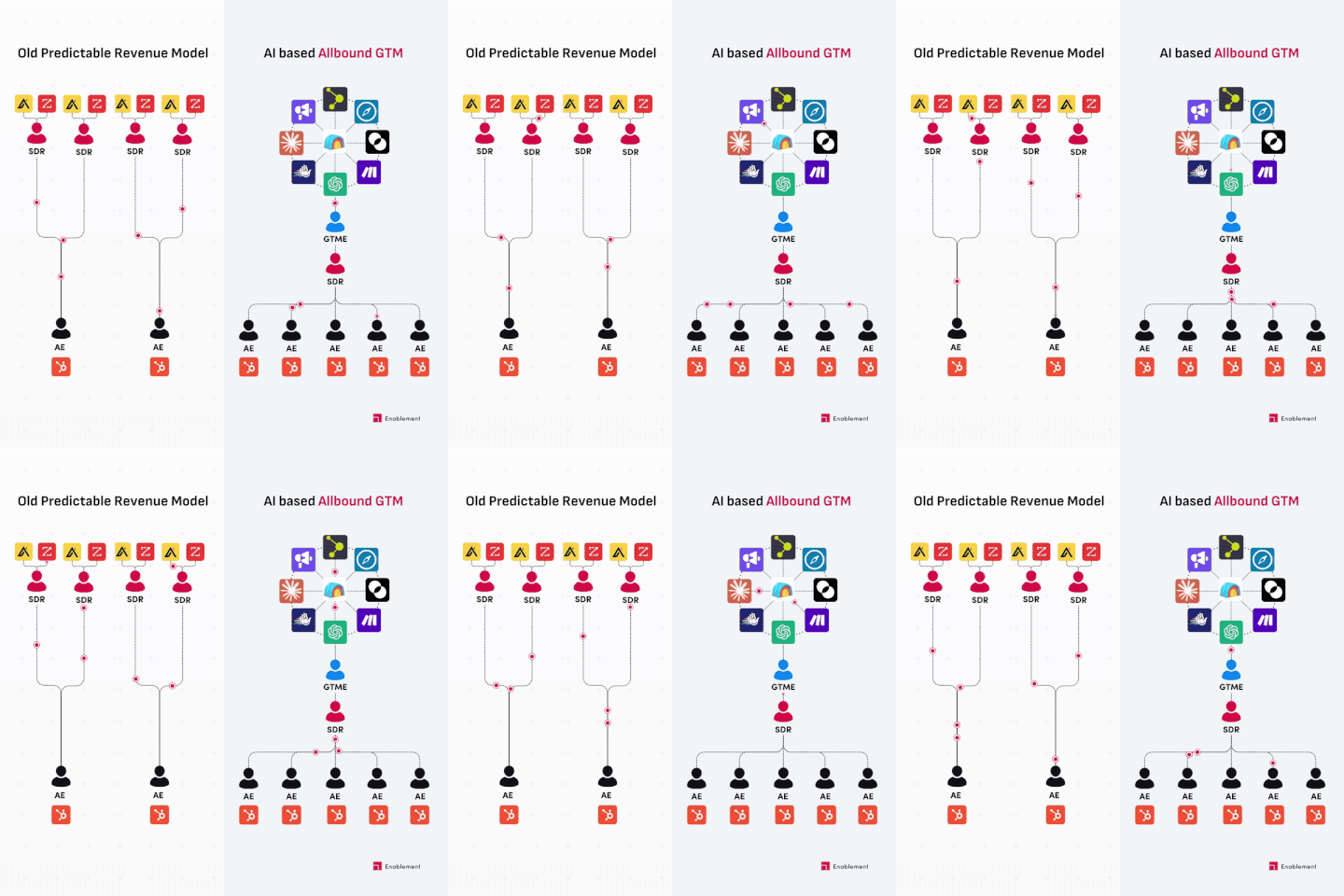
A client was spending $330,000 on their GTM and closed ONE customer only in the last 3 months. We changed their setup and instantly saved $200,000. Here's how: They had the classic "predictable revenue" setup: → 5 SDRs supporting 3 AEs → ZoomInfo for data → Apollo for sequences → HubSpot for CRM All the "right" tools. All the wrong results. Their SDRs had high "activity" but little to show for it: → Manually researching prospects with no buyer intent signals → "Personalized" outreach (wasn't personal at all) → Playing the numbers game They booked some meetings, but the leads were not qualified AT ALL. The fundamental problem wasn't effort. It's the GTM Setup They used a 2020 sales playbook in a 2025 world. We replaced 4 out of 5 SDRs with 1 GTM Engineer and built automated workflows that identify prospects based on dynamic signals: → Teamfluence to track social engagement → Sales Navigator to spot job changes → TheirStack to monitor job openings → Clay for champion tracking We implemented Clay to: → Qualify accounts and leads using AI → Find the right decision-makers → Generate hyper-personalized messages that reference specific pain points To reach out to the leads, we used → Smartlead for emails → Heyreach for LinkedIn → Make to connect the 2 We kept just ONE SDR who focused exclusively on call leads that responded on LinkedIn and email and booked qualified meetings for the AE In the old setup, the costs were massive: → $30,000 for tools alone → $300,000+ for the SDRs I.e. a total of over $330,000. With the new setup, they save 61% and spend less than $10,000 on tools. KEY TAKEAWAY Shift from a 2 SDR to 1 AE ratio to a 1 SDR to 3-5 AE ratio. Shift from tools that support people to tools that replace people. What do you think about this new GTM approach and team setup?

48 reactions 20 comments
Milena AguiarScaling B2B Outreach with Prosp | 50+ calls/month4d

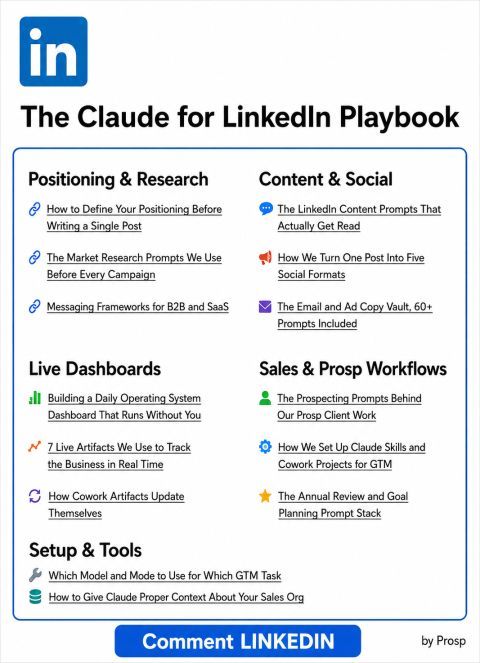
Claude changed how we run LinkedIn for Prosp I stopped treating positioning, content, and outreach as three different parts so I built one connected Claude LinkedIn System around the entire process (full access below)👇 I give it three things: - my profile. - offer. - ICP. then the specialist skills help me move from market research to content, conversations, qualified calls, and clients. Here's what actually happens behind the scenes: 1/ researches the market it studies my ICP, competitors, buying signals, and the problems people are already trying to solve on LinkedIn. this gives me something useful to say. (not another post about consistency.) 2/ sharpens the positioning It connects my offer to what the buyer genuinely cares about because good writing cannot rescue weak positioning. 3/ helps me build the content Posts, hooks, carousels, and lead magnets, using the 60+ prompts across positioning, content, and social. Goal is to get Claude to sound like me. 4/ finds the opportunities It helps identify relevant prospects and warmer conversations through the prospecting workflows. (no random list of 10,000 people or generic connection requests) 5/ supports the conversation It uses actual buyer context and the RevOps playbook to create openers and follow-ups that don't feel redundant 6/ connects everything to revenue profile views, replies, leads, calls, clients, tracked through the live dashboards then it studies what worked and improves the next campaign. this feedback loop is the part most content systems completely miss This process has helped us: → Build 7 live dashboards tracking the business in real time → Run the full sales and prospecting workflow from one system → Cover positioning through to annual goal planning in one playbook → Set up Claude skills and Cowork projects properly, once I eventually expanded it into a full playbook covering the entire LinkedIn lifecycle full access below 👇

7 reactions 19 comments
Facundo Mathias BarbozaSocial Selling for B2B GTM Teams | Sales and Marketing @ Teamfluence™4w

We almost gave up on Linkedin outbound last year. Not because it didn't work. because it kept un-working. We'd got a playbook. The connection template that "gets 40% acceptance." The 30-day posting calendar. The hook formula with a name and an arrow diagram. I'd roll it out, watch it pop for a few weeks, then watch it die. Then i'd go try the next one. For a while i thought i was just bad at this. Turns out i was renting other people's tactics and acting surprised every time they expired. A play only works while it's rare. the second it works, it spreads. The template lands in a thousand sequences and acceptance drops. The "hook" becomes the thing people scroll past. You build for an edge with an expiration date on it. So we stopped copying plays. we built a pipe instead. Now the signals just show up where we already work. - Someone at a target account views a profile or comments, we catch that with Teamfluence. - Clay enriches it. - Claude Code reads it and tells us what it actually means. - Our CRM logs it. - RB2B tells us if they also checked our website. Nobody refreshes a feed. Nobody copy-pastes names into a sheet at 11pm. The difference wasn't effort. it's that we stopped guessing who was ready and started watching who actually was. A playbook is a map. it shows you where everyone already dug. The pipe is the shovel. it works no matter where the gold moves. So if your outbound keeps un-working, maybe you're not bad at it. Maybe you just keep buying the map. What's the last linkedin "playbook" you got for that stopped working? be honest.

1 reactions 1 comments
Antonio TopalovicFounder @mbold.io | From Content to Closed Won | We help b2b leaders publish on LinkedIn, warm up their market and surface social signals to guide outreach when buyers are ready1mo

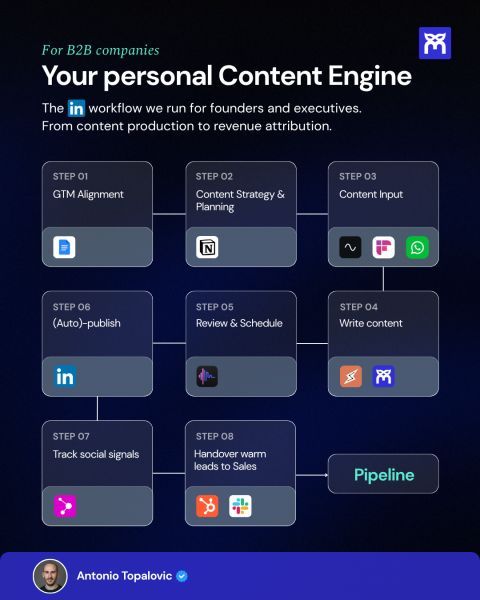
I built this LinkedIn content system for a SaaS CEO. After 37 posts, we could attribute €318K in pipeline to his thought leadership. (took him under an hour a week) Here's the workflow & how we connect content to sales: 𝟭. 𝗚𝗧𝗠 𝗮𝗹𝗶𝗴𝗻𝗺𝗲𝗻𝘁 & 𝗦𝘁𝗿𝗮𝘁𝗲𝗴𝘆 First we learn all the company context: the ICP, messaging, and positioning. This is the backbone of the content strategy. 𝟮. 𝗖𝗼𝗻𝘁𝗲𝗻𝘁 𝗠𝗮𝗻𝗮𝗴𝗲𝗺𝗲𝗻𝘁 From there we build the Linkedin strategy and decide on content pillars - Educational to build credibility - Personal to build connection - Industry POV to position as a category leader - (Occasional organisational and promotional posts) We use Notion to plan our content calendar and manage production 𝟯. 𝗚𝗲𝘁 𝗶𝗻𝗽𝘂𝘁 𝗳𝗿𝗼𝗺 𝘁𝗵𝗲 𝗖𝗘𝗢 Once the direction is set, we: - run bi-weekly interviews with Fireflies or Riverside fm. I bring questions from the community, marketing initiatives, or his calendar - have him send voice notes via Whatsapp too. Like spontaneous thoughts after customer calls or random 5-minute monologues on the drive to the office. As a CEO you don't have to go looking for content. The topics jump at you all day, you just need an easy way to capture them. We keep all transcripts of the audio/Video material. That gives us a clean, searchable source documents. 𝟰. 𝗪𝗿𝗶𝘁𝗲 𝘁𝗵𝗲 𝗰𝗼𝗻𝘁𝗲𝗻𝘁 We use Claude co work to keep the context of ICP, product marketing and voice profile. A linkedin writing skill helps us draft, test hooks, try different structures and angles. Every piece is edited by a human watching for context, pacing, and the little nuances that make it feel like a real person thinking. CEO input → Claude in the middle → Human Edit 𝟱. 𝗥𝗲𝘃𝗶𝗲𝘄, 𝗮𝗽𝗽𝗿𝗼𝘃𝗲 & 𝘀𝗰𝗵𝗲𝗱𝘂𝗹𝗲 Posts go to the CEO 80–100% ready. We collaborate in Scripe, where he can comment, request changes, and approve the piece. Then it gets scheduled for publishing. 𝟲. (𝗔𝘂𝘁𝗼-) 𝗽𝘂𝗯𝗹𝗶𝘀𝗵 𝘁𝗼 𝗟𝗶𝗻𝗸𝗲𝗱𝗶𝗻 no need to worry about content going live on time 𝟳. 𝗧𝗿𝗮𝗰𝗸 𝘁𝗵𝗲 𝘀𝗶𝗴𝗻𝗮𝗹𝘀 We track followers, likes, comments, and profile visitors with Teamfluence, then qualify all those contacts against their ICP and score the interactions 𝟴. 𝗛𝗮𝗻𝗱 𝗼𝘃𝗲𝗿 𝘁𝗼 𝘀𝗮𝗹𝗲𝘀 Once a lead passes a threshold, the contact gets pushed to Business Development via Slack. These are warm, ready for outreach. Those scores also get matched to contacts in Hubspot, so we can trace back which deals got influenced by the CEOs linkedin content. --- This workflow turned a CEOs Linkedin profile into a pipeline generating marketing channel. In under an hour a week for the CEO. If you're looking for a system like this, DM me.

8 reactions
Fedor KovalevFounder, Cheetah | We build and run outbound & GTM engines for founders and lean B2B teams1mo

Most ABM software gives sellers more alerts. I think that is the wrong product. A useful system knows every target account, remembers past emails and meetings, notices a real change, and prepares the next move for a person to approve. I wrote a practical guide to building that system. It includes signal campaigns that booked 70 meetings in two months and generated 250+ positive replies in three months, plus the operating model behind Cheetah GTM at CanaryTags. If you sell into a finite market, this issue of GTM Frontier is for you. Read it, steal the three-week build plan, and tell me what I missed.

7 reactions 2 comments
Facundo Mathias BarbozaSocial Selling for B2B GTM Teams | Sales and Marketing @ Teamfluence™1mo

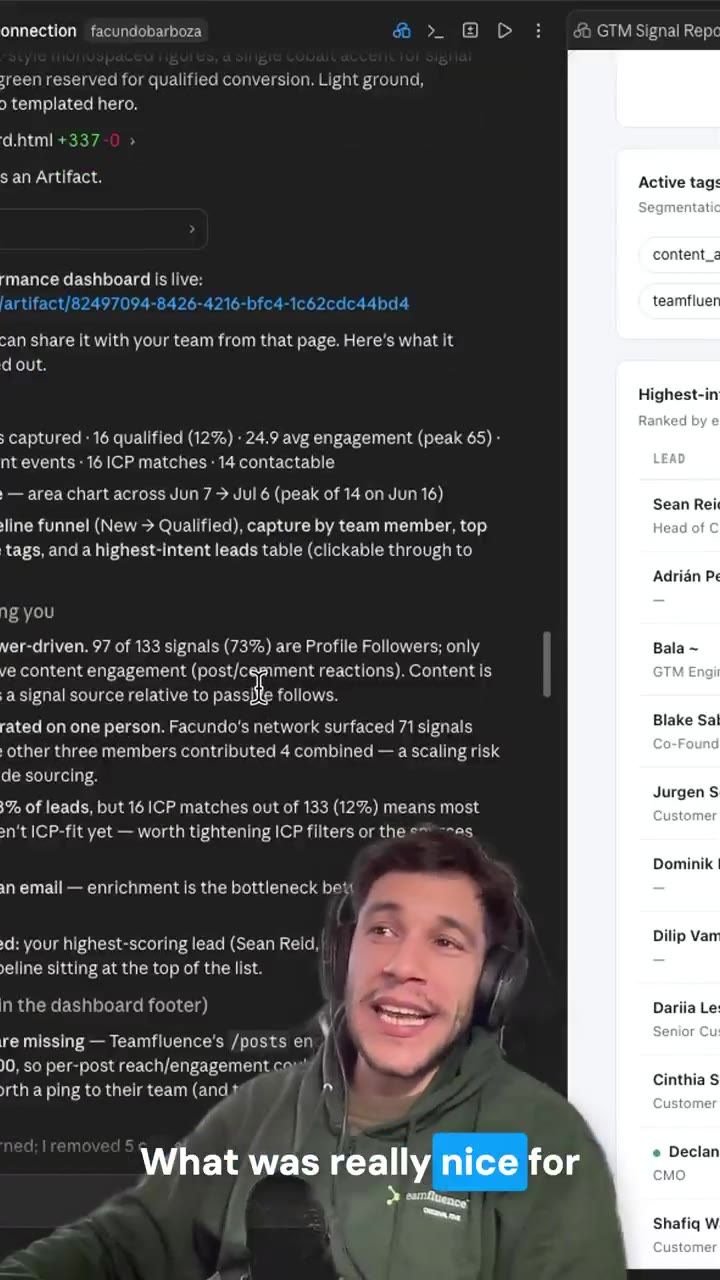
I asked Claude Code to read my own linkedin data back to me. It roasted me 😅 context: I'm a marketer, not technical. I connected Claude Code to my own linkedin signals via Teamfluence and asked it to build me a dashboard. it did. no problem. then it didn't stop at the dashboard. it started telling me what the numbers actually meant. the verdict: i'm way too follower-driven. chasing follows like they pay the bills. my content is underperforming as a signal source. the posts i'm proudest of aren't pulling the people I actually want. and most of the signal capture? one person: me. just me. ouch. also completely fair. but that's was key for me. it didn't just dump my data into a nice chart. it looked at it and told me the truth about my GTM. the stuff you'd normally pay someone to say to your face. that's the shift for me. AI that doesn't just show you your numbers, it tells you what you're getting wrong with them. the full walkthrough is in the comments. if your linkedin data could talk back, what would it say about you? be honest.

4 reactions 1 comments
Guillermo MorcilloCo-founder @ Reverrr | Revenue systems for B2B companies1mo

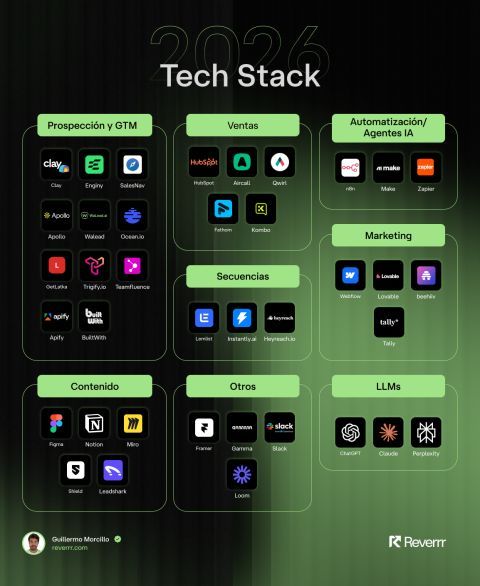
Hemos probado +100 herramientas de ventas, marketing y negocio en los últimos meses… Estas son algunas de las que usamos en Reverrrr: PROSPECCIÓN y GTM - Clay: Cerebro y orquestador GTM - Enginy: Outreach con IA a escala - SalesNav: Prospección en LinkedIn - Apollo: Base de leads + outreach - Walead**:** IA para outreach personalizado - Ocean.io: Empresas similares - GetLatka: Base SaaS - Trigify.io: Señales en redes - Teamfluence: Visitantes de perfil - Apify: Scraping personalizado - BuiltWith: Stack tecnológico VENTAS - HubSpot: CRM central - Aircall: Llamadas integradas - Qwilr: Propuestas interactivas - Fathom: Grabación de reuniones - Kombo: Cold calling + coaching SECUENCIAS - Lemlist: Email + LinkedIn personalizado - Instantly.ai: Email outbound a escala - HeyReach.io: DMs automáticos AUTOMATIZACIÓN / AGENTES IA - n8n: Automatización avanzada - Make: Flujos visuales - Zapier: Conexiones simples MARKETING - Webflow: Web sin código - Lovable: Campañas creativas - beehiiv: Newsletters - Tally: Formularios CONTENIDO - Figma: Diseño colaborativo - Notion: Docs + gestión - Miro: Mapas visuales - Shield: Métricas de LinkedIn - LeadShark: lead magnets en piloto automático LLMs - ChatGPT: Generación de texto - Claude: Escritura avanzada - Perplexity: Búsqueda con IA OTHER - Framer: diseño y desarrollo web - Gamma: presentaciones con IA - Slack: Mensajería interna - Loom: Vídeo Y si, el budget se te puede ir de las manos 😅 👀 ¿Cuál añadirías?

4 reactions 3 comments
Lanny M. Heiz ✨Content → Pipeline for B2B Founders at $1-5M ARR | Clay Enterprise Partner | Founder @ Enablement1mo

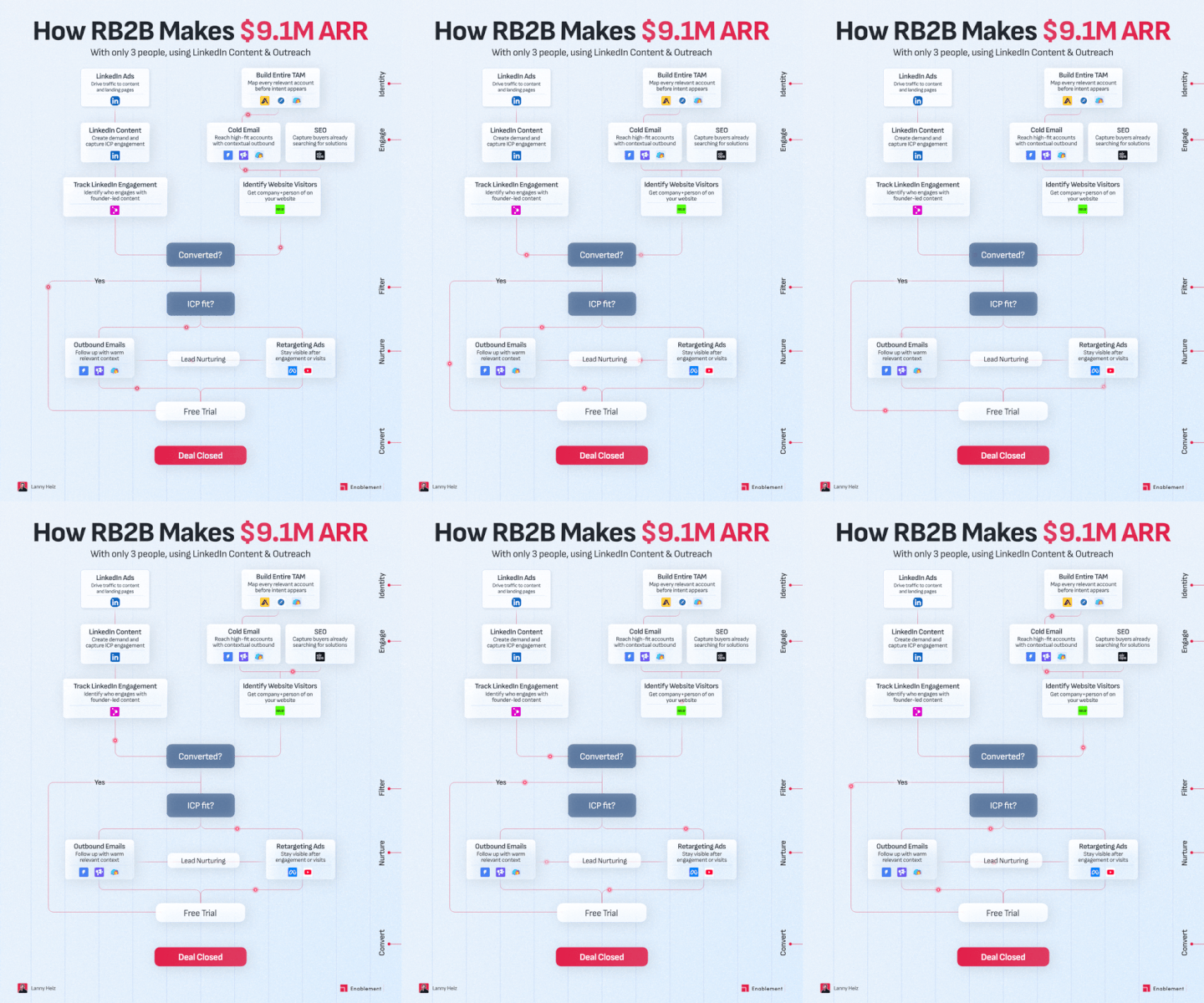
Adam Robinson grew RB2B from 0 to $9,362,489 ARR in 24 months - with ZERO funding and only 3 people. He broke down his GTM strategy to grow to $10m ARR with just one person. Here's his 8 Step playbook ATTRACTION STAGE   1/ LinkedIn Content   Adam is the GOAT of founder-led marketing and is documenting his journey.   After analysing 10,000 viral post, here's how go viral: → Visuals are key (gif, flowcharts, memes) → Take a clear stance (don't be vanilla) → Share results & learnings → "How I" not "How to" → Strong hook   It's also our strongest channel, bringing in $80k new sales a month. Tks to our n8n AI Agents, it takes me only around 2h a week.   2/ Thought Leadership Ads   Goal: - Expand audience - Build your brand - Create trust   How you do it: → Sponsor your best performing posts → Exclude customers & followers → Go for max reach   3/ SEO   Attracting people who already KNOW their problem (how to identify website visitors). Even if they don't convert, Adam can identify them (with rb2b) + retarget them with emails + ads   Types of content: → Landing pages → How-to's → Listicles   4/ Cold Email   40% of RB2B's customers come through email. They message their entire TAM 1x a month with a short message.   Step-by-step to do the same: → Build entire TAM list (apollo, salesnav, clay etc) → Sending 1 email a month to entire TAM → Full focus on deliverability → Great & simpassadle offer   CONVERSION STAGE   5/ Website & Landing pages   Adam created the "ugliest website in SaaS" (his words, not mine).   Why it works: → Cuts through the noise → No-brainer offer (free forever)   6/ Allbound Email   Because people have a lot of touchpoints on LinkedIn and the website, RB2B can now retarget them with Allbound Emails.   How you do it: → Identify LI interactions Teamfluence™ → Identify website visitors (RB2B or Syft Data ) → Score Leads for ICP fit (Clay) → Add to email campaign   7/ Retargeting Ads   In addition to Allbound Emails, retarget your website visitors with ads   Channels: → Youtube → Meta   Formats: → Selfie Videos → On Desk / Talking Heads    𝗖𝗟𝗢𝗦𝗜𝗡𝗚 𝗦𝗧𝗔𝗚𝗘   8/ Closing the deal   The goal of all the efforts above is to convert people into trial customers. Once they see how many leads they were missing out on before, purchasing RB2B becomes a no-brainer.   Adams brand creates so much trust that they don't even need a salesperson anymore.   TAKEAWAY → Build a strong brand on LinkedIn → Follow up with Email (and ads) → Bootstrap to $6m ARR and beyond → Have F-U money because it's mostly profit (and no VC)@ Adam, Taylor Haren, Alex Fine🌲 tell me where I went wrong -  you know the exact details as you actually run it.

43 reactions 16 comments
Ivan PericCEO @ contentmotion.io | Interview-getriebene Content-Systeme für B2B SaaS & IT | Pipeline durch Thought Leadership-Content | Für Marketing Teams & Founder im DACH-Markt1mo

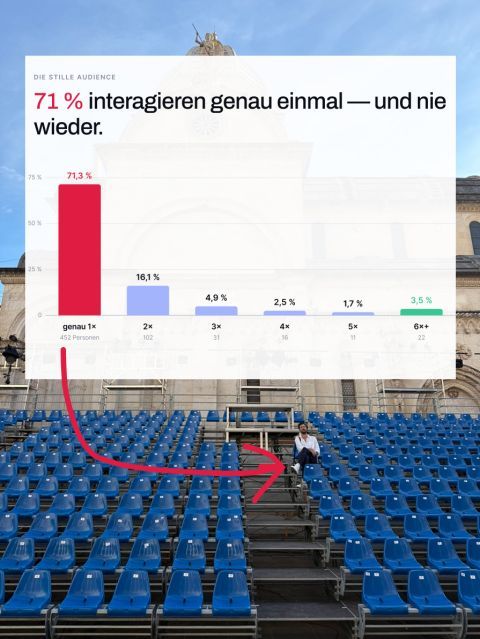
Ich habe immer geglaubt, dass man sich hier auf Linkedin eine loyale Fanbase aufbaut. Dann die Daten: 71% interagieren genau 1x und nie wieder. Deine loyale Audience? Gibt es nicht. Als ich vor einigen Woche bei einem Webinar von Teamfluence vorbeigeschaut habe, hat jemand im Raum genau diese These aufgestellt. Ich konnte es zunächst nicht glauben. Ich wollte es für uns selbst nachmessen. Also habe ich mir ein Kundenprofil geschnappt, welches wir auf über 27k Follower aufgebaut haben - man würde meinen hier steckt eine loyale Audience hinter. Die letzten 32 Posts über 3 Monate ausgewertet — 634 externe Personen, die interagiert (Like oder Comment) haben. Die Daten: → 71% interagieren einmal → 16% ein zweites Mal → der wirklich loyale Rest ist verschwindend klein (Ehrlich dazu: Die stillen Leser, die nie interagieren, kannst du nicht tracken. Die sind vermutlich der größte Teil…) Das liest sich nicht nach einem Publikum, das dich kontinurllich begleitet. Das war der erste Kunde. Wir ziehen die Analyse gerade über weitere Kunden durch… Was heißt das jetzt aber wenn 71% nicht wiederkommen? Naja - jede einzelne Interaktion ist potenziell dein einziger Schuss eine Beziehung aufzubauen. Und gerade diese Arbeit ist die, die maaaassiv unterschätzt wird, obwohl genau diese Arbeit die höchste Wahrscheinlichkeit für qualifizierte Anfragen ist. Busy Execs haben hierfür keine Zeit, sodass hier so unfassbar viel Potenzial verschenkt wird - darum investieren wir hier gerade viel Energie und Ressource hineien, um genau dieses Problem zu lösen. Also: Du bekommst pro Post eine Handvoll Fremder gezeigt — und entscheidest jedes Mal neu: verschenken oder ansprechen.

6 reactions 1 comments
Ivan PericCEO @ contentmotion.io | Interview-getriebene Content-Systeme für B2B SaaS & IT | Pipeline durch Thought Leadership-Content | Für Marketing Teams & Founder im DACH-Markt1mo

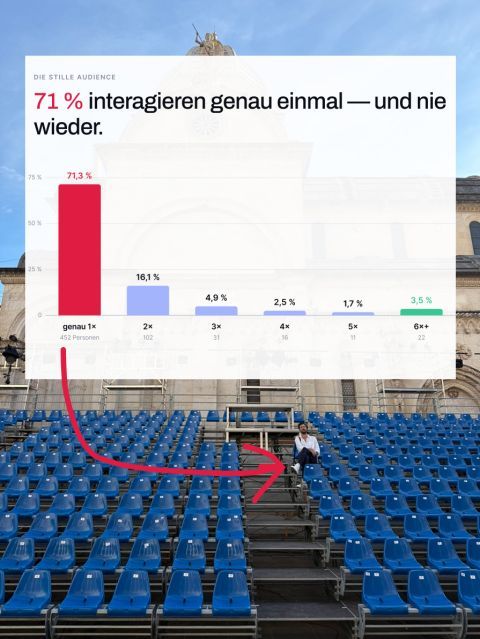
Ich habe immer geglaubt, dass man sich hier auf Linkedin eine loyale Fanbase aufbaut. Dann die Daten: 71% interagieren genau 1x und nie wieder. Deine loyale Audience? Gibt es nicht. Als ich vor einigen Woche bei einem Webinar von Teamfluence vorbeigeschaut habe, hat jemand im Raum genau diese These aufgestellt. Ich konnte es zunächst nicht glauben. Ich wollte es für uns selbst nachmessen. Also habe ich mir ein Kundenprofil geschnappt, welches wir auf über 27k Follower aufgebaut haben - man würde meinen hier steckt eine loyale Audience hinter. Die letzten 32 Posts über 3 Monate ausgewertet — 634 externe Personen, die interagiert (Like oder Comment) haben. Die Daten: → 71% interagieren einmal → 16% ein zweites Mal → der wirklich loyale Rest ist verschwindend klein (Ehrlich dazu: Die stillen Leser, die nie interagieren, kannst du nicht tracken. Die sind vermutlich der größte Teil…) Das liest sich nicht nach einem Publikum, das dich kontinurllich begleitet. Das war der erste Kunde. Wir ziehen die Analyse gerade über weitere Kunden durch… Was heißt das jetzt aber wenn 71% nicht wiederkommen? Naja - jede einzelne Interaktion ist potenziell dein einziger Schuss eine Beziehung aufzubauen. Und gerade diese Arbeit ist die, die maaaassiv unterschätzt wird, obwohl genau diese Arbeit die höchste Wahrscheinlichkeit für qualifizierte Anfragen ist. Busy Execs haben hierfür keine Zeit, sodass hier so unfassbar viel Potenzial verschenkt wird - darum investieren wir hier gerade viel Energie und Ressource hineien, um genau dieses Problem zu lösen. Also: Du bekommst pro Post eine Handvoll Fremder gezeigt — und entscheidest jedes Mal neu: verschenken oder ansprechen.

6 reactions 1 comments
Megha SharmaCo-Founder @ONEGTMLAB | AI GTM & CONTENT Systems for B2B Tech | SaaS • Cyber • DevTools1mo

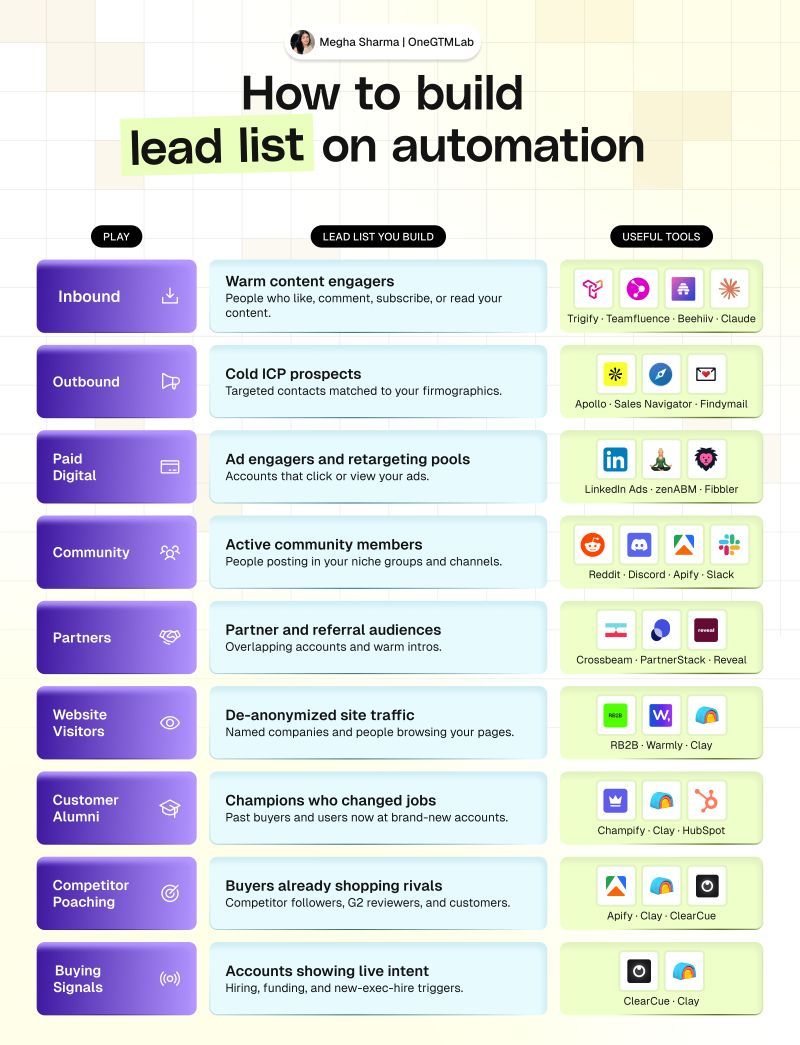
We've built GTM strategies for 60+ companies. These are the 9 plays we see working right now 👇 1️⃣ Inbound → Warm content engagers  People who like, comment, or read your content.  Tools: Trigify, Teamfluence, Beehiiv, Claude 2️⃣ Outbound → Cold ICP prospects  Targeted contacts matched to your firmographics.  Tools: Apollo, Sales Navigator, Findymail 3️⃣ Paid Digital → Ad engagers & retargeting pools  Accounts clicking or viewing your ads.  Tools: LinkedIn Ads, zenABM, Fibbler 4️⃣ Community → Active niche members  People posting in your groups and channels.  Tools: Reddit, Discord, Apify, Slack 5️⃣ Partners → Referral audiences  Overlapping accounts and warm intros.  Tools: Crossbeam, PartnerStack, Reveal 6️⃣ Website Visitors → De-anonymized traffic  Named companies browsing your pages.  Tools: RB2B, Warmly, Clay 7️⃣ Customer Alumni → Champions who changed jobs  Past buyers now at brand-new accounts.  Tools: Champify, Clay, HubSpot 8️⃣ Competitor Poaching → Buyers already shopping rivals  Competitor followers, G2 reviewers, customers.  Tools: Apify, Clay, ClearCue 9️⃣ Buying Signals → Accounts showing live intent  Hiring, funding, and new-exec triggers.  Tools: ClearCue, Clay Every winning list starts with a signal, not a database. Databases go stale. Signals never do. Which of these 9 plays is missing from your motion? ♻️ Repost to help a founder still building lists manually. P.S.If you are looking to build the right lead generation channel for your company, I am just a call away. Link is in my bio

87 reactions 39 comments
Bill StathopoulosCEO, SalesCaptain | Clay London Club Lead 👑 | Top lemlist Partner 📬 | Investor | GTM Advisor for $10M+ B2B SaaS1mo

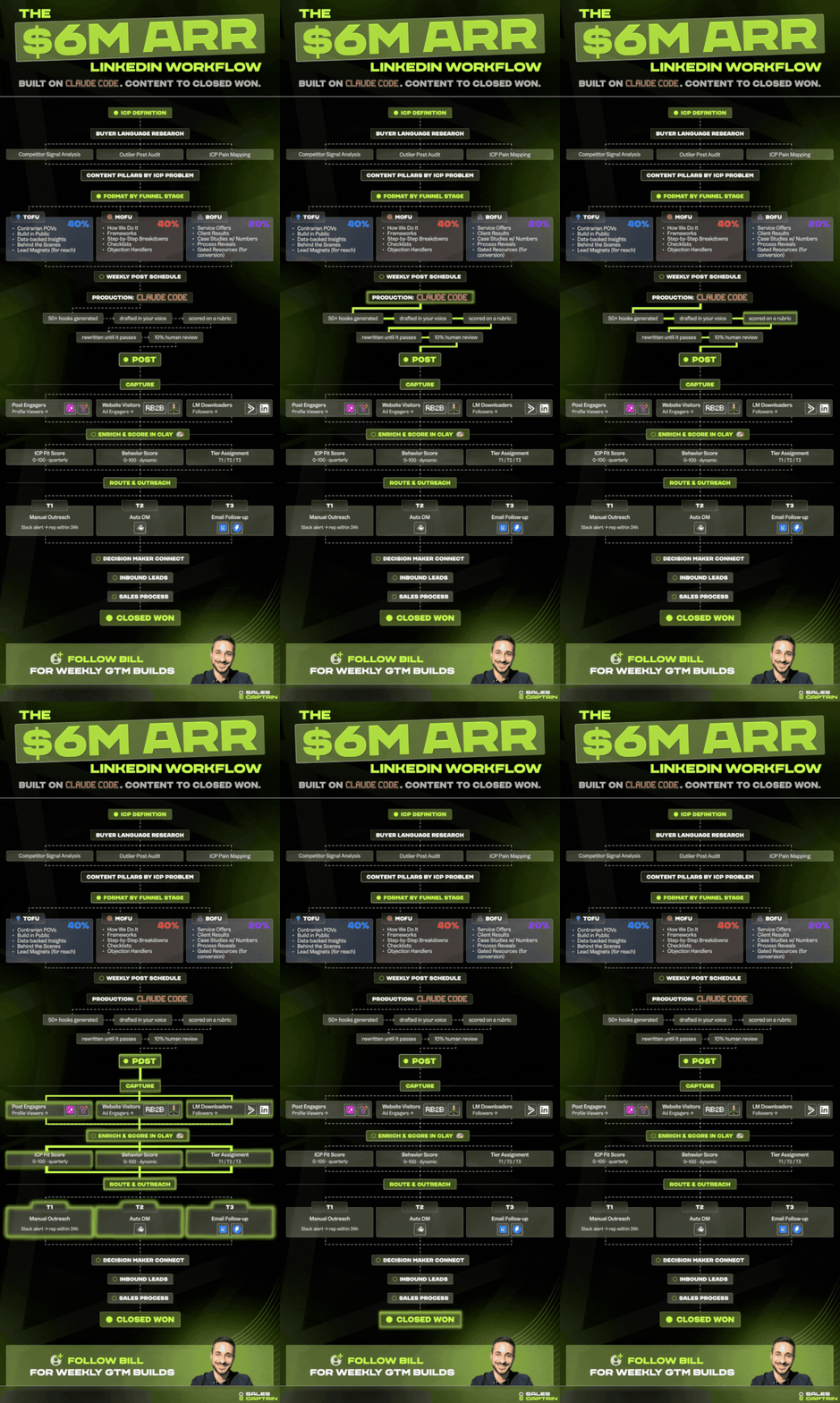
It's June, and LinkedIn has already generated $800k in pipeline for us. The whole of last year it did $1M. Here's the exact system behind it. 2 notes before we get into it: 1️⃣ LinkedIn has become one of our strongest channels on the way to $6M ARR (we are sharing the journey on LI, so make sure you follow). 2️⃣ We don't post for reach, every post is built to generate signal, and we capture all of it. The full system is in the breakdown below. (Here's the TL;DR version): - Every post starts in Claude Code, hooks generated, written in the right voice, scored, and human-reviewed. - Trigify.io and Teamfluence catch the engagers and profile viewers. - RB2B catches the site visitors, ZenABM catches ad engagers. - Clay enriches and scores every lead. Every lead lands as T1, T2, or T3. - Slack alerts the rep on the hot ones. - HeyReach runs the warm DMs. - lemlist and Instantly.ai handle the rest. LinkedIn caps you at 400 new connection requests a month. That's the wall most outbound hits. But, messaging people already in your network isn't capped. So the content engine isn't just lead-gen. Every follower it earns is someone you can DM without burning a connection request. Build audience, and you raise your outbound ceiling. We wrote the whole thing up in our LinkedIn Outbound Playbook. 25 pages, 7 workflows, the full stack, and a 30-day plan to run it yourself. Link in the comments below. 👍 Like if you thought this is helpful. ♻️ Repost to help your network Love, peace and growth 💚

44 reactions 23 comments
Marios CharalampousGTM Engineering Consultant @ Workflows.io | Architecting go-to-market systems for hypergrowth B2B companies1mo

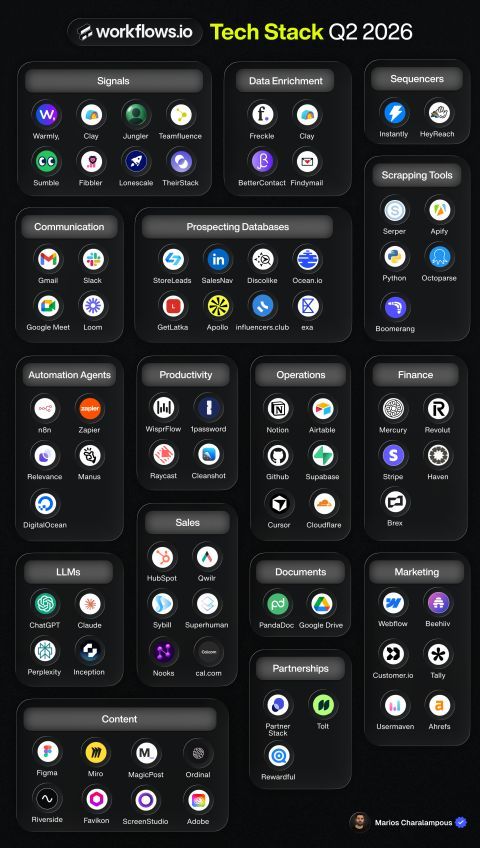
Our current monthly tech spend is more than $20k As an AI-native GTM services company we made a decision early on: never compromise on technology. Here's each technology we use and why: 1️⃣ Signals: Clay: Prebuilt and custom buying signals Warmly,: Website visitor identification Jungler.ai: Social engagement signals Teamfluence: LinkedIn profile visitors Sumble: Technographics Fibbler: LinkedIn ad engagement data LoneScale: Job changes TheirStack: Job openings 2️⃣ Data Enrichment Clay: GTM orchestration Freckle.io: CRM enrichment Findymail: Email data BetterContact: Waterfall email and phone enrichment 3️⃣ Sequencers Instantly.ai: Automated email campaigns HeyReach.io: Automated LinkedIn DM campaigns 4️⃣ Scraping Tools Serper: Google scraping Apify: Marketplace of custom scrapers Python: For scraping directories at scale Octoparse - Octopus Data Inc.: Advanced scraping workflows 5️⃣ Prospecting Databases Apollo.io: Companies and people searches LinkedIn Sales Nav: Full stakeholder mapping DiscoLike: In-depth TAM mapping Ocean.io: Lookalike company lists GetLatka: SaaS-focused database Store Leads: eCommerce database influencers.club: Influencer database Exa: AI-powered targeted list building 6️⃣ Communication Gmail: Email communication Slack: Team and client communication Google Meet: Video meetings Loom: Video explainers and SOPs 7️⃣ Automation / Agents n8n: Flexible automation and agents Zapier: Simple automations Relevance AI: Prompt-based agent builder Manus AI: Quick agentic outputs DigitalOcean: Self-hosting infrastructure 8️⃣ LLMs ChatGPT: Everyday use cases Claude: Complex writing and client projects Gemini: Web research 9️⃣ Productivity Whisprflow: One-click speech-to-text 1Password: Password management Raycast: Mac productivity shortcuts Cleanshot: Gif recording and organized screenshots 🔟 SALES HubSpot: CRM Qwilr: Sales proposals and decks Superhuman: Email management Nooks: Cold calling Cal.com: Meeting scheduling Sybill: AI meeting recorder and revenue intelligence 1️⃣ 1️⃣ Partnerships PartnerStack/Tolt/Rewardful: Affiliate platforms 1️⃣ 2️⃣ Marketing Webflow: Website hosting beehiiv: Newsletter platform Customer.io: Marketing automation Tally: Form builder Usermaven: Website analytics Ahrefs: SEO research 1️⃣ 3️⃣ Content Figma: Design Miro: Workflow mapping MagicPost: AI writing Ordinal: Schedule posts and LinkedIn analytics Riverside: Interviews and podcasts Favikon: Creator research Screen Studio: Screen recording Adobe: Video production 1️⃣ 4️⃣ Operations Notion: Knowledge hub and project management Airtable: Automation database GitHub: Code storage Supabase: Outbound data and agent backend Cursor: AI coding environment Cloudflare: Domain hosting 1️⃣ 5️⃣ Finance Mercury: Banking Revolut: International transfers Stripe: Payment processing Brex: Corporate cards 1️⃣ 6️⃣ Documents Google Drive: Templates and client documentation PandaDoc: Contracts

67 reactions 27 comments
Santiago FausTurning founder stories into revenue | LinkedIn-led GTM systems | Founder at Maribou | Podcast host | History nerd1mo

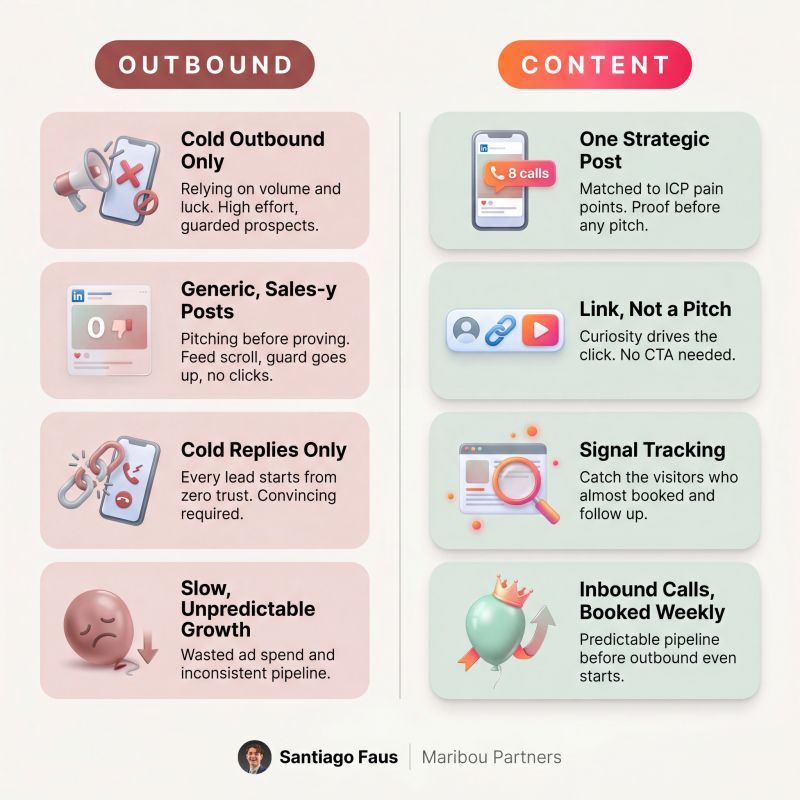
The GTM space bet everything on outbound. Content was the actual unlock. My client booked 8 calls from one LinkedIn post. Before we sent a single cold email. Content is the face of your business. And the broken piece in most GTM strategies. Ram a CTA down someone's feed and their guard goes up immediately. They know you are selling. But match your content to the exact problem your ICP has, paired with the exact solution you offer, and you never have to sell anything. They sell themselves. That is the whole game. A prospect who comes from your content, to your website, to a booked call on your calendar is already halfway sold before you say hello. The best leads you'll ever talk to. Most agencies still treat LinkedIn like a megaphone. Post, pitch, repeat. Wonder why nobody books. LinkedIn was never built for pitching. It was built for proving. Every post is a chance to show your ICP you understand their problem better than the agency that pitched them yesterday. That is what makes it the easiest platform in GTM to generate inbound. No other platform lets a stranger watch you think, agree with how you think, and arrive at your calendar already convinced. Cold email cannot do that. Paid ads cannot do that. Only content, compounding in front of the right audience, does that. Here is how we built that path for our clients. Curate content to your ICP. Post in a sequence that follows their buyer's journey. Random topics get random followers. Strategic topics get strategic buyers. Skip the CTA. Our best leads never came from "DM me." They came from the link on our profile. People click when they are curious, not when they are told to. Turn that link into a VSL. State the problem in their words. State the outcome in simple language. Then stack case studies until doubt runs out. Track who almost converted. Teamfluence and RB2B show you the accounts and visitors who made it to your site, maybe even to your calendar, and stopped short. Depending on volume, automate the follow up or just pick up the phone (my personal favorite.) The first step in all of it is still the content. Everything after is just removing friction, and curating the journey.

112 reactions 29 comments
Bala ~GTM Engineer @Stamina1mo

8 signals that tell you a deal is forming. All from platforms you don't own. Part 8/14 · 2026 ABM Playbook 2nd party signals are buying intent happening outside your stack. Someone comparing, hiring, clicking, engaging before they ever raise their hand. → THERE ARE SIGNALS EVERYWHERE. YOU JUST HAVE TO KNOW WHERE TO LOOK AND   HOW TO TRACK. ─── STAGE 08 · 2ND PARTY SIGNALS ─── 1️⃣ Hiring & Growth - Crustdata (YC F24) / PredictLeads What a company hires for tells you what they're about to buy. A new RevOps job posting = they're building the function. 20%+ headcount growth in 3 months = budget is available and moving. 2️⃣ Ad Engagement - ZenABM / Fibbler 5 ad interactions from a Tier 1 account in 2 weeks, no form fill. That's not anonymous traffic. That's a warm account. Reach out with context instead of a cold opener. 3️⃣ Review Intent - G2 / Trustpilot Someone at a target account viewed your profile then a competitor's. That's an active shortlist. G2 Buyer Intent surfaces this at company level. Act on it now, not next week. 4️⃣ Partner Overlap - Crossbeam / PartnerStack Your tech partner already has a relationship with accounts on your TAL. Crossbeam shows the overlap without exposing raw CRM data. That account gets a warm intro, not a cold sequence. 5️⃣ LinkedIn Signals - Trigify.io / Teamfluence A Tier 1 contact commented on your teammate's post. Teamfluence maps exactly who from which account is in your team's network and who has a 1st-degree connection you can activate. 5️⃣ Custom Signals - Clay / n8n Build your own triggers. Job change alert. Funding round fired. Competitor customer detected via partner overlap. Clay fetches the data, enriches it, and routes it as a CRM action. Off-the-shelf signals miss your ICP. Custom ones don't. 6️⃣ Warm Intros - Commsor 🦕 / The Swarm 🔆 Before any Tier 1 account enters a cold sequence, check if someone on your team, customer base, or investor network has a connection. A warm intro gets 3-4x the reply rate of cold outbound. 7️⃣ Community Activity - Common Room Three people from the same account active in your Slack or Discord = team evaluation in progress. A developer asking implementation questions = trial is running. Escalate to AE before the thread goes cold. ────────────────────── My personal view on this: 2nd party is where a deal announces itself before any conversation starts. The prospect is comparing, researching, building internal consensus - and you're not in the room. The teams that catch this early stop selling cold. The ones that don't keep wondering why their reply rates are dropping. FULL INTERACTIVE PLAYBOOK LINK IS IN THE COMMENT Save this if you're building ABM from scratch. #ABM #GTMEngineer #AccountBasedMarketing #SignalTracking

16 reactions 3 comments
Angelee CarandangContent @ Workflows.io | Growth playbooks using AI2mo

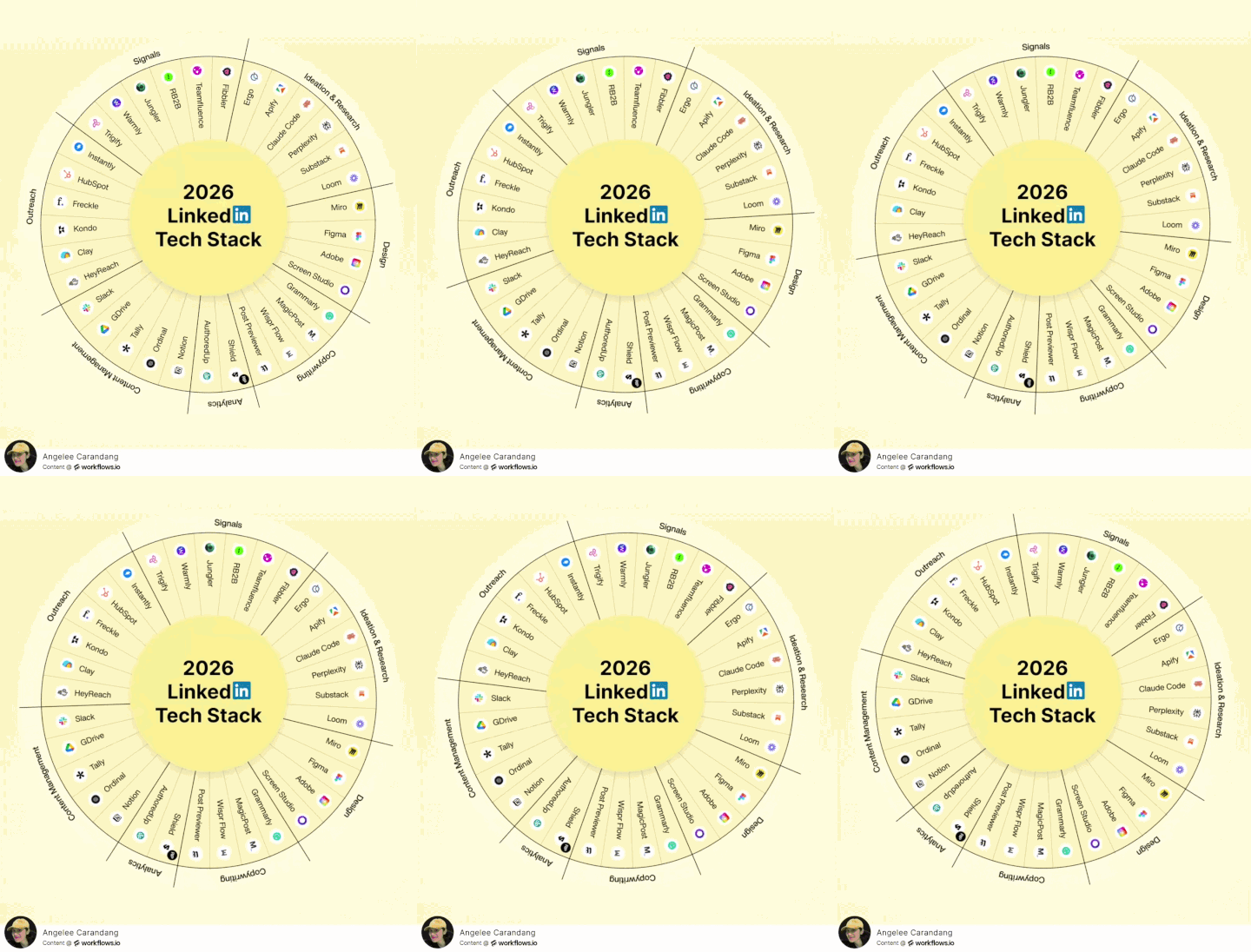
You can’t turn LinkedIn into an inbound channel without a tech stack. Here are 33 tools we’ve tried, tested, and set up for ourselves and clients: IDEATION & RESEARCH: Claude - stores all your context Perplexity - researches the web Substack - read long-form articles Loom - record your workflows Apify - extract top posts CONTENT MANAGEMENT: Notion - content pipeline Ordinal - content scheduling Tally - email capture GDrive - file database Slack - communications DESIGN: Miro - draft designs and layouts Figma - polished visuals and infographics Adobe - animated GIFs and video launches Screen Studio - screen recordings COPYWRITING: Grammarly - checks for typos MagicPost - formats for readability Wispr Flow - brain dumps via voice notes Post Previewer - optimize the hook and format ANALYTICS: Shield - RIP had a great run, but they’ve stopped operating AuthoredUp - you have to click a button per post to extract impressions SIGNALS: Ergo - call transcripts Jungler.ai - post engagement tracking Warmly, - website visitor identification RB2B - website visitor identification Teamfluence - profile views Trigify - social listening Fibbler - LinkedIn ads OUTREACH: HeyReach - LinkedIn outreach Clay - data orchestration & enrichment Freckle.io - data orchestration & enrichment Instantly.ai - email outreach Kondo - LinkedIn inbox HubSpot - CRM Did I miss any good ones?

48 reactions 31 comments
Lanny M. Heiz ✨Content → Pipeline for B2B Founders at $1-5M ARR | Clay Enterprise Partner | Founder @ Enablement2mo

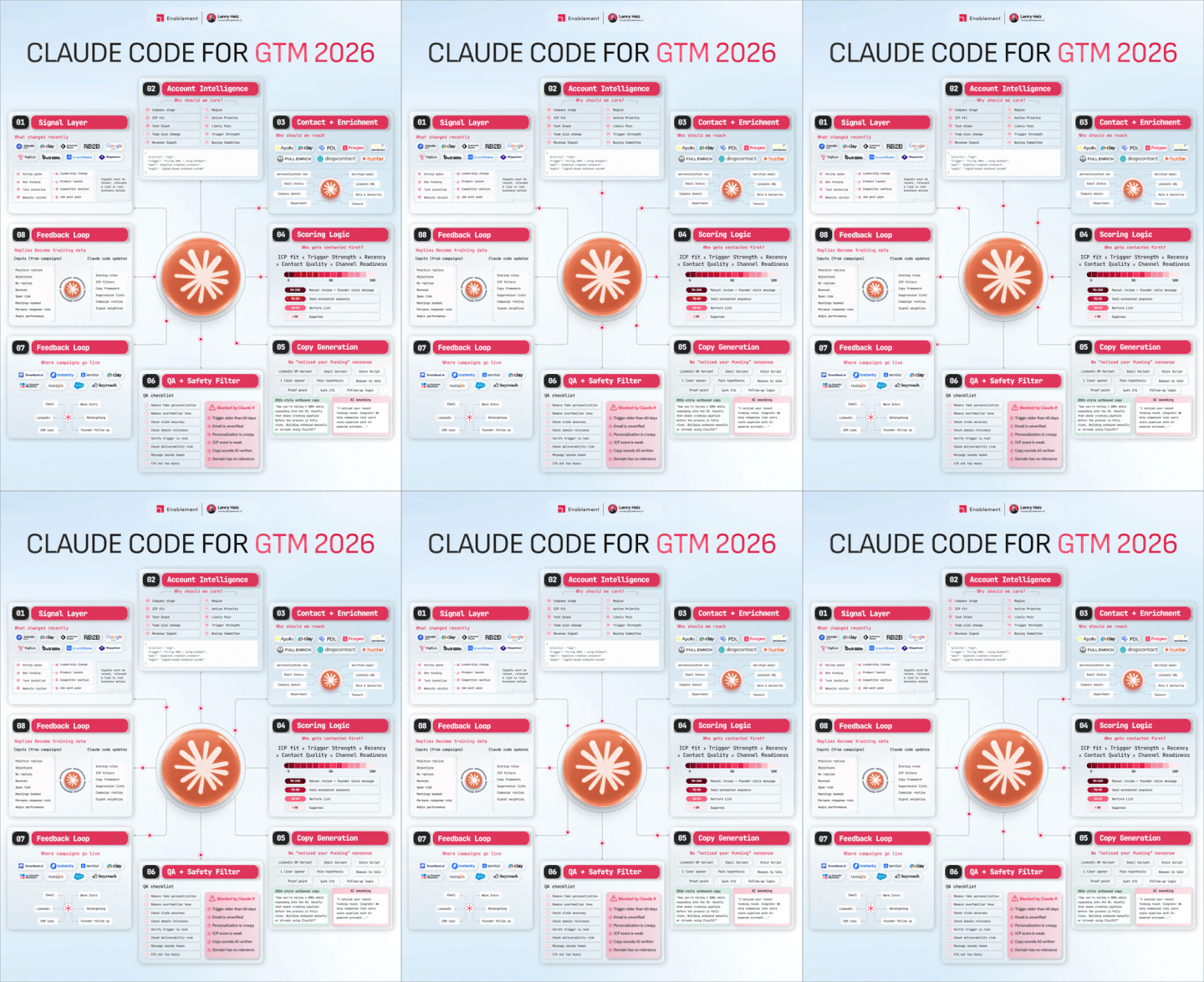
We rebuilt outbound for 113 GTM teams. This is the workflow we run for them with Claude Code   Most operators still confuse a sequence with an engine.   A sequence is: "hey {firstName}, saw you work at {company}."   An engine is 4 layers wired together in Claude Code.   1/ Signal RB2B, Fibbler, Trigify, TheirStack, Teamfluence, Jungler. Clay for signals only.   These tell us when something changed and who to look at.   2/ Enrichment Runs inside Claude Code. Prospeo and LeadMagic in a waterfall for company and contact data.   No dashboards. No CSV exports. The agent pulls what it needs and moves on.   3/ Scoring Two scores per lead, not one.   → Account fit: size, industry, sales team size, technographics → Problem awareness: signal strength × recency × frequency   Then we route:   → 90+ → ABM. Manual review. LinkedIn DM. Add to ad campaign. → 70-89 → automated outbound. → Below 70 → ignored. Don't touch.   4/ Learning A campaign agent in Claude Code reads every campaign. It tracks which messages drove positive replies and which booked meetings in our CRM. Then, it tests new copy variations against the current best performers.   Copy gets better week by week. Without anyone touching it.   Old outbound: spray and pray.   New outbound: signal → enrich → score → route → learn → repeat.   Layer 4 is the one nobody builds but everyone needs.

123 reactions 18 comments
Ivan PericCEO @ contentmotion.io | Interview-getriebene Content-Systeme für B2B SaaS & IT | Pipeline durch Thought Leadership-Content | Für Marketing Teams & Founder im DACH-Markt4mo

40% aller Engagement-Signale auf LinkedIn sind Post-Likes. Nur 9% davon matchen deinen ICP. Company-Page-Follower? 70% ICP-Match. Die meisten Teams optimieren auf das falsche Signal. Hier auf LinkedIn werden täglich Hacks für Linkedin geteilt: Hook-Formeln, Posting-Zeiten, Algorithmus-Tricks. Alles schön und gut - für Einzelpersonen. Aber LinkedIn als GTM-Team für hohe ACVs und lange Verkaufszyklen nutzen Als echten Pipeline-Kanal, bei dem Marketing und Sales auf die gleichen Signale schauen? Das ist ein komplett anderes Biest und da hilft kein 5-min Hack. Ich habe Facundo Mathias Barboza von TeamFluence interviewt und er hat mit uns sein Vorgehen geteilt, wie Marketing und Sales Teams gemeinsam als Team Pipeline aufbauen können. Kein Magic Hack. Kein Lead Magnet (den du bereut hast herunterzuladen). Drei Phasen: (1) Netzwerk aufräumen - alte Kontakte raus, gezielte Connections rein. Marketing liefert ICP-Listen, Sales führt aus. (2) Signale qualifizieren - nicht jeder Like zählt gleich. Lerne, echte Kaufsignale vom Noise zu trennen. (3) Handoff & Timing - 45 % der Prospects interagieren nur einmal. Wer zu langsam reagiert, verliert sie. Zu jedem Zeitpunkt entscheidend: Kein Pitch. Ehrliche Gespräche. Vertrauen aufbauen. Das Ergebnis bei TeamFluence: ICP-Match 3x höher. Reply-Rate +40 %. Close Rate +15 %. Die meisten B2B-Teams verbrennen Monate auf LinkedIn, weil Marketing Likes jagt und Sales auf Leads wartet, die nie kommen. Die Lösung ist kein Magic Hack - sondern ein Team, das auf die gleichen Signale schaut und diese strukturiert nutzt. Das vollständige Interview mit konkreten Schritten findest du in der neuen Ausgabe unseres Newsletters.

16 reactions 2 comments
Sumit N.RevOps & GTM Architect for B2B Product & Services | Turning Chaotic Growth into Predictable Revenue Engines | $10M+ Pipeline Generated | HubSpot · Salesforce · Clay · AI Automation1d

There are 5 levels of using Claude for GTM. Most teams never pass level 1. That's level one. Most never leave it. Here's what the levels actually look like when you're running revenue work through it. Level 1. Ask it questions, copy the answer. This is where 90% of RevOps teams stop. Fine for drafting a subject line. Useless for anything that touches your actual pipeline. Level 2. Feed it your real data, not hypotheticals. Stop asking "write me a cold email." Start feeding it your actual reply rates, your actual ICP, your actual objections from last week's calls. The output changes completely once it has context instead of guesses. Level 3. Wire it into your tools, not your tabs. Once Claude Code can talk to Apollo.io, Instantly.ai, and HeyReach directly, you stop copying data between five browser tabs. You're not asking Claude about your outreach anymore. It's running inside it. Level 4. Build the skill once, reuse it forever. Level 5. Stress test before you trust it. Before Opus 4.7 touched my LinkedIn revenue system, I ran it against edge cases on purpose: bad data, ambiguous replies, conflicting signals. Most people skip this step and find out the hard way when a real prospect gets a broken sequence. Honest caveat: none of this replaces knowing your numbers. Claude will happily automate a bad process faster than you can catch it. The teams that win here already know what "good" looks like before they hand it off. Where's your GTM stack still stuck at level one?
Christian PlascenciaFounder @ Pipeline.tech | Full TAM Coverage GTM3d

The traditional SDR playbook is dead. 1 modern SDR can now match the output of 10. Here's how the sales landscape has shifted: ❌ Traditional SDR playbook > Manually creating prospect lists > Writing out individual cold emails by hand > Calling only cold outbound leads all day ✅ Modern SDR playbook (AI-enabled) > Vibe-coding full TAM lists with Claude Code & Clay > Sending 1,000s of emails + LinkedIn DMs per day > Posting LinkedIn content to generate personal inbound > Spends more time calling warm leads generated from automated motions vs cold calling The most AI forward B2B sales orgs know this and are 2-5Xing their revenue per rep. Here’s how the brightest B2B orgs are implementing the modern SDR playbook: 𝐓𝐡𝐞 𝐌𝐨𝐝𝐞𝐫𝐧 𝐒𝐃𝐑 𝐏𝐥𝐚𝐲𝐛𝐨𝐨𝐤 There are 3 primary actions the SDR owns: 1. Automated outbound 2. LinkedIn content + evergreen motions 3. Warm calling How each works: 1️⃣ AUTOMATED OUTBOUND SDRs will run cold email + LinkedIn connection campaigns everyday. Instead of manually handpicking leads through Sales Navigator, we’ll use Claude Code to build niche account lists or Clay CLI to build TAM lists connecting enrichment tools such as Prospeo, Icypeas, and GetLeads for maximum coverage. Lists will be added to automatically sequenced campaigns, email personalization will be generated for each lead through Clay, and script variants will be added to the email sequencer for testing. Outbound Tech Stack: ↳ Domains: Porkbun ↳ Inboxes: ScaledMail (Google) ↳ Sequencer: EmailBison ↳ List Building: Clay ↳ Enrichment: Icypeas, Prospeo, GetLeads ↳ Verification: MillionVerifier, BounceBan ↳ Automation: Claude Code 2️⃣ LINKEDIN CONTENT + EVERGREEN MOTIONS SDRs will post content & set up automated workflows to capture engagement. Content to post: - Thought leadership (sales, product, team) - Personal experiences (personal growth, events, stories) - Repurposing team content (educational content) - Company updates (milestones, product changes) SDRs post 3-5 times per week. Engagement will be funneled into Clay using following tech stack: ↳ Trigify.io: scrape personal LinkedIn engagement on posts ↳ Teamfluence: scrape personal profile visitors ↳ Typeform/HubSpot: capture email opt-ins on lead magnets Inside Clay, we’ll qualify all inbound leads with Claygent’s research function. All qualified leads will then be pushed to an automated sequence or warm called. 3️⃣ WARM CALLING SDRs will call all outbound/inbound interested leads within 5 minutes. Speed to lead is ESSENTIAL here, nearly 400% more leads convert when called within 5 minutes of an engagement (cited by Harvard Business Review) The concept is simple: Call The Damn Leads. Meeting book rate will skyrocket. Calling Tech Stack: ↳ Dialer: Salesfinity ↳ Phone # enrichment: Prospeo, TitanX [[[ POST CONTINUED IN COMMENTS ]]]

68 reactions 17 comments
Gilbert KralingerContent ​> GTM systems ​> Sales Pipeline 📈 Revenue Architect & GTM Engineer 🤖 Clay Enterprise Partner3d

A client was spending $330,000 on their GTM and closed ONE customer only in the last 3 months. We changed their setup and instantly saved $200,000. Here's how: They had the classic "predictable revenue" setup: → 5 SDRs supporting 3 AEs → ZoomInfo for data → Apollo for sequences → HubSpot for CRM All the "right" tools. All the wrong results. Their SDRs had high "activity" but little to show for it: → Manually researching prospects with no buyer intent signals → "Personalized" outreach (wasn't personal at all) → Playing the numbers game They booked some meetings, but the leads were not qualified AT ALL. The fundamental problem wasn't effort. It's the GTM Setup They used a 2020 sales playbook in a 2025 world. We replaced 4 out of 5 SDRs with 1 GTM Engineer and built automated workflows that identify prospects based on dynamic signals: → Teamfluence to track social engagement → Sales Navigator to spot job changes → TheirStack to monitor job openings → Clay for champion tracking We implemented Clay to: → Qualify accounts and leads using AI → Find the right decision-makers → Generate hyper-personalized messages that reference specific pain points To reach out to the leads, we used → Smartlead for emails → Heyreach for LinkedIn → Make to connect the 2 We kept just ONE SDR who focused exclusively on call leads that responded on LinkedIn and email and booked qualified meetings for the AE In the old setup, the costs were massive: → $30,000 for tools alone → $300,000+ for the SDRs I.e. a total of over $330,000. With the new setup, they save 61% and spend less than $10,000 on tools. KEY TAKEAWAY Shift from a 2 SDR to 1 AE ratio to a 1 SDR to 3-5 AE ratio. Shift from tools that support people to tools that replace people. What do you think about this new GTM approach and team setup?

48 reactions 20 comments
Milena AguiarScaling B2B Outreach with Prosp | 50+ calls/month4d

Claude changed how we run LinkedIn for Prosp I stopped treating positioning, content, and outreach as three different parts so I built one connected Claude LinkedIn System around the entire process (full access below)👇 I give it three things: - my profile. - offer. - ICP. then the specialist skills help me move from market research to content, conversations, qualified calls, and clients. Here's what actually happens behind the scenes: 1/ researches the market it studies my ICP, competitors, buying signals, and the problems people are already trying to solve on LinkedIn. this gives me something useful to say. (not another post about consistency.) 2/ sharpens the positioning It connects my offer to what the buyer genuinely cares about because good writing cannot rescue weak positioning. 3/ helps me build the content Posts, hooks, carousels, and lead magnets, using the 60+ prompts across positioning, content, and social. Goal is to get Claude to sound like me. 4/ finds the opportunities It helps identify relevant prospects and warmer conversations through the prospecting workflows. (no random list of 10,000 people or generic connection requests) 5/ supports the conversation It uses actual buyer context and the RevOps playbook to create openers and follow-ups that don't feel redundant 6/ connects everything to revenue profile views, replies, leads, calls, clients, tracked through the live dashboards then it studies what worked and improves the next campaign. this feedback loop is the part most content systems completely miss This process has helped us: → Build 7 live dashboards tracking the business in real time → Run the full sales and prospecting workflow from one system → Cover positioning through to annual goal planning in one playbook → Set up Claude skills and Cowork projects properly, once I eventually expanded it into a full playbook covering the entire LinkedIn lifecycle full access below 👇

7 reactions 19 comments
Facundo Mathias BarbozaSocial Selling for B2B GTM Teams | Sales and Marketing @ Teamfluence™4w

We almost gave up on Linkedin outbound last year. Not because it didn't work. because it kept un-working. We'd got a playbook. The connection template that "gets 40% acceptance." The 30-day posting calendar. The hook formula with a name and an arrow diagram. I'd roll it out, watch it pop for a few weeks, then watch it die. Then i'd go try the next one. For a while i thought i was just bad at this. Turns out i was renting other people's tactics and acting surprised every time they expired. A play only works while it's rare. the second it works, it spreads. The template lands in a thousand sequences and acceptance drops. The "hook" becomes the thing people scroll past. You build for an edge with an expiration date on it. So we stopped copying plays. we built a pipe instead. Now the signals just show up where we already work. - Someone at a target account views a profile or comments, we catch that with Teamfluence. - Clay enriches it. - Claude Code reads it and tells us what it actually means. - Our CRM logs it. - RB2B tells us if they also checked our website. Nobody refreshes a feed. Nobody copy-pastes names into a sheet at 11pm. The difference wasn't effort. it's that we stopped guessing who was ready and started watching who actually was. A playbook is a map. it shows you where everyone already dug. The pipe is the shovel. it works no matter where the gold moves. So if your outbound keeps un-working, maybe you're not bad at it. Maybe you just keep buying the map. What's the last linkedin "playbook" you got for that stopped working? be honest.

1 reactions 1 comments
Antonio TopalovicFounder @mbold.io | From Content to Closed Won | We help b2b leaders publish on LinkedIn, warm up their market and surface social signals to guide outreach when buyers are ready1mo

I built this LinkedIn content system for a SaaS CEO. After 37 posts, we could attribute €318K in pipeline to his thought leadership. (took him under an hour a week) Here's the workflow & how we connect content to sales: 𝟭. 𝗚𝗧𝗠 𝗮𝗹𝗶𝗴𝗻𝗺𝗲𝗻𝘁 & 𝗦𝘁𝗿𝗮𝘁𝗲𝗴𝘆 First we learn all the company context: the ICP, messaging, and positioning. This is the backbone of the content strategy. 𝟮. 𝗖𝗼𝗻𝘁𝗲𝗻𝘁 𝗠𝗮𝗻𝗮𝗴𝗲𝗺𝗲𝗻𝘁 From there we build the Linkedin strategy and decide on content pillars - Educational to build credibility - Personal to build connection - Industry POV to position as a category leader - (Occasional organisational and promotional posts) We use Notion to plan our content calendar and manage production 𝟯. 𝗚𝗲𝘁 𝗶𝗻𝗽𝘂𝘁 𝗳𝗿𝗼𝗺 𝘁𝗵𝗲 𝗖𝗘𝗢 Once the direction is set, we: - run bi-weekly interviews with Fireflies or Riverside fm. I bring questions from the community, marketing initiatives, or his calendar - have him send voice notes via Whatsapp too. Like spontaneous thoughts after customer calls or random 5-minute monologues on the drive to the office. As a CEO you don't have to go looking for content. The topics jump at you all day, you just need an easy way to capture them. We keep all transcripts of the audio/Video material. That gives us a clean, searchable source documents. 𝟰. 𝗪𝗿𝗶𝘁𝗲 𝘁𝗵𝗲 𝗰𝗼𝗻𝘁𝗲𝗻𝘁 We use Claude co work to keep the context of ICP, product marketing and voice profile. A linkedin writing skill helps us draft, test hooks, try different structures and angles. Every piece is edited by a human watching for context, pacing, and the little nuances that make it feel like a real person thinking. CEO input → Claude in the middle → Human Edit 𝟱. 𝗥𝗲𝘃𝗶𝗲𝘄, 𝗮𝗽𝗽𝗿𝗼𝘃𝗲 & 𝘀𝗰𝗵𝗲𝗱𝘂𝗹𝗲 Posts go to the CEO 80–100% ready. We collaborate in Scripe, where he can comment, request changes, and approve the piece. Then it gets scheduled for publishing. 𝟲. (𝗔𝘂𝘁𝗼-) 𝗽𝘂𝗯𝗹𝗶𝘀𝗵 𝘁𝗼 𝗟𝗶𝗻𝗸𝗲𝗱𝗶𝗻 no need to worry about content going live on time 𝟳. 𝗧𝗿𝗮𝗰𝗸 𝘁𝗵𝗲 𝘀𝗶𝗴𝗻𝗮𝗹𝘀 We track followers, likes, comments, and profile visitors with Teamfluence, then qualify all those contacts against their ICP and score the interactions 𝟴. 𝗛𝗮𝗻𝗱 𝗼𝘃𝗲𝗿 𝘁𝗼 𝘀𝗮𝗹𝗲𝘀 Once a lead passes a threshold, the contact gets pushed to Business Development via Slack. These are warm, ready for outreach. Those scores also get matched to contacts in Hubspot, so we can trace back which deals got influenced by the CEOs linkedin content. --- This workflow turned a CEOs Linkedin profile into a pipeline generating marketing channel. In under an hour a week for the CEO. If you're looking for a system like this, DM me.

8 reactions
Fedor KovalevFounder, Cheetah | We build and run outbound & GTM engines for founders and lean B2B teams1mo

Most ABM software gives sellers more alerts. I think that is the wrong product. A useful system knows every target account, remembers past emails and meetings, notices a real change, and prepares the next move for a person to approve. I wrote a practical guide to building that system. It includes signal campaigns that booked 70 meetings in two months and generated 250+ positive replies in three months, plus the operating model behind Cheetah GTM at CanaryTags. If you sell into a finite market, this issue of GTM Frontier is for you. Read it, steal the three-week build plan, and tell me what I missed.

7 reactions 2 comments
Facundo Mathias BarbozaSocial Selling for B2B GTM Teams | Sales and Marketing @ Teamfluence™1mo

I asked Claude Code to read my own linkedin data back to me. It roasted me 😅 context: I'm a marketer, not technical. I connected Claude Code to my own linkedin signals via Teamfluence and asked it to build me a dashboard. it did. no problem. then it didn't stop at the dashboard. it started telling me what the numbers actually meant. the verdict: i'm way too follower-driven. chasing follows like they pay the bills. my content is underperforming as a signal source. the posts i'm proudest of aren't pulling the people I actually want. and most of the signal capture? one person: me. just me. ouch. also completely fair. but that's was key for me. it didn't just dump my data into a nice chart. it looked at it and told me the truth about my GTM. the stuff you'd normally pay someone to say to your face. that's the shift for me. AI that doesn't just show you your numbers, it tells you what you're getting wrong with them. the full walkthrough is in the comments. if your linkedin data could talk back, what would it say about you? be honest.

4 reactions 1 comments
Guillermo MorcilloCo-founder @ Reverrr | Revenue systems for B2B companies1mo

Hemos probado +100 herramientas de ventas, marketing y negocio en los últimos meses… Estas son algunas de las que usamos en Reverrrr: PROSPECCIÓN y GTM - Clay: Cerebro y orquestador GTM - Enginy: Outreach con IA a escala - SalesNav: Prospección en LinkedIn - Apollo: Base de leads + outreach - Walead**:** IA para outreach personalizado - Ocean.io: Empresas similares - GetLatka: Base SaaS - Trigify.io: Señales en redes - Teamfluence: Visitantes de perfil - Apify: Scraping personalizado - BuiltWith: Stack tecnológico VENTAS - HubSpot: CRM central - Aircall: Llamadas integradas - Qwilr: Propuestas interactivas - Fathom: Grabación de reuniones - Kombo: Cold calling + coaching SECUENCIAS - Lemlist: Email + LinkedIn personalizado - Instantly.ai: Email outbound a escala - HeyReach.io: DMs automáticos AUTOMATIZACIÓN / AGENTES IA - n8n: Automatización avanzada - Make: Flujos visuales - Zapier: Conexiones simples MARKETING - Webflow: Web sin código - Lovable: Campañas creativas - beehiiv: Newsletters - Tally: Formularios CONTENIDO - Figma: Diseño colaborativo - Notion: Docs + gestión - Miro: Mapas visuales - Shield: Métricas de LinkedIn - LeadShark: lead magnets en piloto automático LLMs - ChatGPT: Generación de texto - Claude: Escritura avanzada - Perplexity: Búsqueda con IA OTHER - Framer: diseño y desarrollo web - Gamma: presentaciones con IA - Slack: Mensajería interna - Loom: Vídeo Y si, el budget se te puede ir de las manos 😅 👀 ¿Cuál añadirías?

4 reactions 3 comments
Lanny M. Heiz ✨Content → Pipeline for B2B Founders at $1-5M ARR | Clay Enterprise Partner | Founder @ Enablement1mo

Adam Robinson grew RB2B from 0 to $9,362,489 ARR in 24 months - with ZERO funding and only 3 people. He broke down his GTM strategy to grow to $10m ARR with just one person. Here's his 8 Step playbook ATTRACTION STAGE   1/ LinkedIn Content   Adam is the GOAT of founder-led marketing and is documenting his journey.   After analysing 10,000 viral post, here's how go viral: → Visuals are key (gif, flowcharts, memes) → Take a clear stance (don't be vanilla) → Share results & learnings → "How I" not "How to" → Strong hook   It's also our strongest channel, bringing in $80k new sales a month. Tks to our n8n AI Agents, it takes me only around 2h a week.   2/ Thought Leadership Ads   Goal: - Expand audience - Build your brand - Create trust   How you do it: → Sponsor your best performing posts → Exclude customers & followers → Go for max reach   3/ SEO   Attracting people who already KNOW their problem (how to identify website visitors). Even if they don't convert, Adam can identify them (with rb2b) + retarget them with emails + ads   Types of content: → Landing pages → How-to's → Listicles   4/ Cold Email   40% of RB2B's customers come through email. They message their entire TAM 1x a month with a short message.   Step-by-step to do the same: → Build entire TAM list (apollo, salesnav, clay etc) → Sending 1 email a month to entire TAM → Full focus on deliverability → Great & simpassadle offer   CONVERSION STAGE   5/ Website & Landing pages   Adam created the "ugliest website in SaaS" (his words, not mine).   Why it works: → Cuts through the noise → No-brainer offer (free forever)   6/ Allbound Email   Because people have a lot of touchpoints on LinkedIn and the website, RB2B can now retarget them with Allbound Emails.   How you do it: → Identify LI interactions Teamfluence™ → Identify website visitors (RB2B or Syft Data ) → Score Leads for ICP fit (Clay) → Add to email campaign   7/ Retargeting Ads   In addition to Allbound Emails, retarget your website visitors with ads   Channels: → Youtube → Meta   Formats: → Selfie Videos → On Desk / Talking Heads    𝗖𝗟𝗢𝗦𝗜𝗡𝗚 𝗦𝗧𝗔𝗚𝗘   8/ Closing the deal   The goal of all the efforts above is to convert people into trial customers. Once they see how many leads they were missing out on before, purchasing RB2B becomes a no-brainer.   Adams brand creates so much trust that they don't even need a salesperson anymore.   TAKEAWAY → Build a strong brand on LinkedIn → Follow up with Email (and ads) → Bootstrap to $6m ARR and beyond → Have F-U money because it's mostly profit (and no VC)@ Adam, Taylor Haren, Alex Fine🌲 tell me where I went wrong -  you know the exact details as you actually run it.

43 reactions 16 comments
Ivan PericCEO @ contentmotion.io | Interview-getriebene Content-Systeme für B2B SaaS & IT | Pipeline durch Thought Leadership-Content | Für Marketing Teams & Founder im DACH-Markt1mo

Ich habe immer geglaubt, dass man sich hier auf Linkedin eine loyale Fanbase aufbaut. Dann die Daten: 71% interagieren genau 1x und nie wieder. Deine loyale Audience? Gibt es nicht. Als ich vor einigen Woche bei einem Webinar von Teamfluence vorbeigeschaut habe, hat jemand im Raum genau diese These aufgestellt. Ich konnte es zunächst nicht glauben. Ich wollte es für uns selbst nachmessen. Also habe ich mir ein Kundenprofil geschnappt, welches wir auf über 27k Follower aufgebaut haben - man würde meinen hier steckt eine loyale Audience hinter. Die letzten 32 Posts über 3 Monate ausgewertet — 634 externe Personen, die interagiert (Like oder Comment) haben. Die Daten: → 71% interagieren einmal → 16% ein zweites Mal → der wirklich loyale Rest ist verschwindend klein (Ehrlich dazu: Die stillen Leser, die nie interagieren, kannst du nicht tracken. Die sind vermutlich der größte Teil…) Das liest sich nicht nach einem Publikum, das dich kontinurllich begleitet. Das war der erste Kunde. Wir ziehen die Analyse gerade über weitere Kunden durch… Was heißt das jetzt aber wenn 71% nicht wiederkommen? Naja - jede einzelne Interaktion ist potenziell dein einziger Schuss eine Beziehung aufzubauen. Und gerade diese Arbeit ist die, die maaaassiv unterschätzt wird, obwohl genau diese Arbeit die höchste Wahrscheinlichkeit für qualifizierte Anfragen ist. Busy Execs haben hierfür keine Zeit, sodass hier so unfassbar viel Potenzial verschenkt wird - darum investieren wir hier gerade viel Energie und Ressource hineien, um genau dieses Problem zu lösen. Also: Du bekommst pro Post eine Handvoll Fremder gezeigt — und entscheidest jedes Mal neu: verschenken oder ansprechen.

6 reactions 1 comments
Ivan PericCEO @ contentmotion.io | Interview-getriebene Content-Systeme für B2B SaaS & IT | Pipeline durch Thought Leadership-Content | Für Marketing Teams & Founder im DACH-Markt1mo

Ich habe immer geglaubt, dass man sich hier auf Linkedin eine loyale Fanbase aufbaut. Dann die Daten: 71% interagieren genau 1x und nie wieder. Deine loyale Audience? Gibt es nicht. Als ich vor einigen Woche bei einem Webinar von Teamfluence vorbeigeschaut habe, hat jemand im Raum genau diese These aufgestellt. Ich konnte es zunächst nicht glauben. Ich wollte es für uns selbst nachmessen. Also habe ich mir ein Kundenprofil geschnappt, welches wir auf über 27k Follower aufgebaut haben - man würde meinen hier steckt eine loyale Audience hinter. Die letzten 32 Posts über 3 Monate ausgewertet — 634 externe Personen, die interagiert (Like oder Comment) haben. Die Daten: → 71% interagieren einmal → 16% ein zweites Mal → der wirklich loyale Rest ist verschwindend klein (Ehrlich dazu: Die stillen Leser, die nie interagieren, kannst du nicht tracken. Die sind vermutlich der größte Teil…) Das liest sich nicht nach einem Publikum, das dich kontinurllich begleitet. Das war der erste Kunde. Wir ziehen die Analyse gerade über weitere Kunden durch… Was heißt das jetzt aber wenn 71% nicht wiederkommen? Naja - jede einzelne Interaktion ist potenziell dein einziger Schuss eine Beziehung aufzubauen. Und gerade diese Arbeit ist die, die maaaassiv unterschätzt wird, obwohl genau diese Arbeit die höchste Wahrscheinlichkeit für qualifizierte Anfragen ist. Busy Execs haben hierfür keine Zeit, sodass hier so unfassbar viel Potenzial verschenkt wird - darum investieren wir hier gerade viel Energie und Ressource hineien, um genau dieses Problem zu lösen. Also: Du bekommst pro Post eine Handvoll Fremder gezeigt — und entscheidest jedes Mal neu: verschenken oder ansprechen.

6 reactions 1 comments
Megha SharmaCo-Founder @ONEGTMLAB | AI GTM & CONTENT Systems for B2B Tech | SaaS • Cyber • DevTools1mo

We've built GTM strategies for 60+ companies. These are the 9 plays we see working right now 👇 1️⃣ Inbound → Warm content engagers  People who like, comment, or read your content.  Tools: Trigify, Teamfluence, Beehiiv, Claude 2️⃣ Outbound → Cold ICP prospects  Targeted contacts matched to your firmographics.  Tools: Apollo, Sales Navigator, Findymail 3️⃣ Paid Digital → Ad engagers & retargeting pools  Accounts clicking or viewing your ads.  Tools: LinkedIn Ads, zenABM, Fibbler 4️⃣ Community → Active niche members  People posting in your groups and channels.  Tools: Reddit, Discord, Apify, Slack 5️⃣ Partners → Referral audiences  Overlapping accounts and warm intros.  Tools: Crossbeam, PartnerStack, Reveal 6️⃣ Website Visitors → De-anonymized traffic  Named companies browsing your pages.  Tools: RB2B, Warmly, Clay 7️⃣ Customer Alumni → Champions who changed jobs  Past buyers now at brand-new accounts.  Tools: Champify, Clay, HubSpot 8️⃣ Competitor Poaching → Buyers already shopping rivals  Competitor followers, G2 reviewers, customers.  Tools: Apify, Clay, ClearCue 9️⃣ Buying Signals → Accounts showing live intent  Hiring, funding, and new-exec triggers.  Tools: ClearCue, Clay Every winning list starts with a signal, not a database. Databases go stale. Signals never do. Which of these 9 plays is missing from your motion? ♻️ Repost to help a founder still building lists manually. P.S.If you are looking to build the right lead generation channel for your company, I am just a call away. Link is in my bio

87 reactions 39 comments
Bill StathopoulosCEO, SalesCaptain | Clay London Club Lead 👑 | Top lemlist Partner 📬 | Investor | GTM Advisor for $10M+ B2B SaaS1mo

It's June, and LinkedIn has already generated $800k in pipeline for us. The whole of last year it did $1M. Here's the exact system behind it. 2 notes before we get into it: 1️⃣ LinkedIn has become one of our strongest channels on the way to $6M ARR (we are sharing the journey on LI, so make sure you follow). 2️⃣ We don't post for reach, every post is built to generate signal, and we capture all of it. The full system is in the breakdown below. (Here's the TL;DR version): - Every post starts in Claude Code, hooks generated, written in the right voice, scored, and human-reviewed. - Trigify.io and Teamfluence catch the engagers and profile viewers. - RB2B catches the site visitors, ZenABM catches ad engagers. - Clay enriches and scores every lead. Every lead lands as T1, T2, or T3. - Slack alerts the rep on the hot ones. - HeyReach runs the warm DMs. - lemlist and Instantly.ai handle the rest. LinkedIn caps you at 400 new connection requests a month. That's the wall most outbound hits. But, messaging people already in your network isn't capped. So the content engine isn't just lead-gen. Every follower it earns is someone you can DM without burning a connection request. Build audience, and you raise your outbound ceiling. We wrote the whole thing up in our LinkedIn Outbound Playbook. 25 pages, 7 workflows, the full stack, and a 30-day plan to run it yourself. Link in the comments below. 👍 Like if you thought this is helpful. ♻️ Repost to help your network Love, peace and growth 💚

44 reactions 23 comments
Marios CharalampousGTM Engineering Consultant @ Workflows.io | Architecting go-to-market systems for hypergrowth B2B companies1mo

Our current monthly tech spend is more than $20k As an AI-native GTM services company we made a decision early on: never compromise on technology. Here's each technology we use and why: 1️⃣ Signals: Clay: Prebuilt and custom buying signals Warmly,: Website visitor identification Jungler.ai: Social engagement signals Teamfluence: LinkedIn profile visitors Sumble: Technographics Fibbler: LinkedIn ad engagement data LoneScale: Job changes TheirStack: Job openings 2️⃣ Data Enrichment Clay: GTM orchestration Freckle.io: CRM enrichment Findymail: Email data BetterContact: Waterfall email and phone enrichment 3️⃣ Sequencers Instantly.ai: Automated email campaigns HeyReach.io: Automated LinkedIn DM campaigns 4️⃣ Scraping Tools Serper: Google scraping Apify: Marketplace of custom scrapers Python: For scraping directories at scale Octoparse - Octopus Data Inc.: Advanced scraping workflows 5️⃣ Prospecting Databases Apollo.io: Companies and people searches LinkedIn Sales Nav: Full stakeholder mapping DiscoLike: In-depth TAM mapping Ocean.io: Lookalike company lists GetLatka: SaaS-focused database Store Leads: eCommerce database influencers.club: Influencer database Exa: AI-powered targeted list building 6️⃣ Communication Gmail: Email communication Slack: Team and client communication Google Meet: Video meetings Loom: Video explainers and SOPs 7️⃣ Automation / Agents n8n: Flexible automation and agents Zapier: Simple automations Relevance AI: Prompt-based agent builder Manus AI: Quick agentic outputs DigitalOcean: Self-hosting infrastructure 8️⃣ LLMs ChatGPT: Everyday use cases Claude: Complex writing and client projects Gemini: Web research 9️⃣ Productivity Whisprflow: One-click speech-to-text 1Password: Password management Raycast: Mac productivity shortcuts Cleanshot: Gif recording and organized screenshots 🔟 SALES HubSpot: CRM Qwilr: Sales proposals and decks Superhuman: Email management Nooks: Cold calling Cal.com: Meeting scheduling Sybill: AI meeting recorder and revenue intelligence 1️⃣ 1️⃣ Partnerships PartnerStack/Tolt/Rewardful: Affiliate platforms 1️⃣ 2️⃣ Marketing Webflow: Website hosting beehiiv: Newsletter platform Customer.io: Marketing automation Tally: Form builder Usermaven: Website analytics Ahrefs: SEO research 1️⃣ 3️⃣ Content Figma: Design Miro: Workflow mapping MagicPost: AI writing Ordinal: Schedule posts and LinkedIn analytics Riverside: Interviews and podcasts Favikon: Creator research Screen Studio: Screen recording Adobe: Video production 1️⃣ 4️⃣ Operations Notion: Knowledge hub and project management Airtable: Automation database GitHub: Code storage Supabase: Outbound data and agent backend Cursor: AI coding environment Cloudflare: Domain hosting 1️⃣ 5️⃣ Finance Mercury: Banking Revolut: International transfers Stripe: Payment processing Brex: Corporate cards 1️⃣ 6️⃣ Documents Google Drive: Templates and client documentation PandaDoc: Contracts

67 reactions 27 comments
Santiago FausTurning founder stories into revenue | LinkedIn-led GTM systems | Founder at Maribou | Podcast host | History nerd1mo

The GTM space bet everything on outbound. Content was the actual unlock. My client booked 8 calls from one LinkedIn post. Before we sent a single cold email. Content is the face of your business. And the broken piece in most GTM strategies. Ram a CTA down someone's feed and their guard goes up immediately. They know you are selling. But match your content to the exact problem your ICP has, paired with the exact solution you offer, and you never have to sell anything. They sell themselves. That is the whole game. A prospect who comes from your content, to your website, to a booked call on your calendar is already halfway sold before you say hello. The best leads you'll ever talk to. Most agencies still treat LinkedIn like a megaphone. Post, pitch, repeat. Wonder why nobody books. LinkedIn was never built for pitching. It was built for proving. Every post is a chance to show your ICP you understand their problem better than the agency that pitched them yesterday. That is what makes it the easiest platform in GTM to generate inbound. No other platform lets a stranger watch you think, agree with how you think, and arrive at your calendar already convinced. Cold email cannot do that. Paid ads cannot do that. Only content, compounding in front of the right audience, does that. Here is how we built that path for our clients. Curate content to your ICP. Post in a sequence that follows their buyer's journey. Random topics get random followers. Strategic topics get strategic buyers. Skip the CTA. Our best leads never came from "DM me." They came from the link on our profile. People click when they are curious, not when they are told to. Turn that link into a VSL. State the problem in their words. State the outcome in simple language. Then stack case studies until doubt runs out. Track who almost converted. Teamfluence and RB2B show you the accounts and visitors who made it to your site, maybe even to your calendar, and stopped short. Depending on volume, automate the follow up or just pick up the phone (my personal favorite.) The first step in all of it is still the content. Everything after is just removing friction, and curating the journey.

112 reactions 29 comments
Bala ~GTM Engineer @Stamina1mo

8 signals that tell you a deal is forming. All from platforms you don't own. Part 8/14 · 2026 ABM Playbook 2nd party signals are buying intent happening outside your stack. Someone comparing, hiring, clicking, engaging before they ever raise their hand. → THERE ARE SIGNALS EVERYWHERE. YOU JUST HAVE TO KNOW WHERE TO LOOK AND   HOW TO TRACK. ─── STAGE 08 · 2ND PARTY SIGNALS ─── 1️⃣ Hiring & Growth - Crustdata (YC F24) / PredictLeads What a company hires for tells you what they're about to buy. A new RevOps job posting = they're building the function. 20%+ headcount growth in 3 months = budget is available and moving. 2️⃣ Ad Engagement - ZenABM / Fibbler 5 ad interactions from a Tier 1 account in 2 weeks, no form fill. That's not anonymous traffic. That's a warm account. Reach out with context instead of a cold opener. 3️⃣ Review Intent - G2 / Trustpilot Someone at a target account viewed your profile then a competitor's. That's an active shortlist. G2 Buyer Intent surfaces this at company level. Act on it now, not next week. 4️⃣ Partner Overlap - Crossbeam / PartnerStack Your tech partner already has a relationship with accounts on your TAL. Crossbeam shows the overlap without exposing raw CRM data. That account gets a warm intro, not a cold sequence. 5️⃣ LinkedIn Signals - Trigify.io / Teamfluence A Tier 1 contact commented on your teammate's post. Teamfluence maps exactly who from which account is in your team's network and who has a 1st-degree connection you can activate. 5️⃣ Custom Signals - Clay / n8n Build your own triggers. Job change alert. Funding round fired. Competitor customer detected via partner overlap. Clay fetches the data, enriches it, and routes it as a CRM action. Off-the-shelf signals miss your ICP. Custom ones don't. 6️⃣ Warm Intros - Commsor 🦕 / The Swarm 🔆 Before any Tier 1 account enters a cold sequence, check if someone on your team, customer base, or investor network has a connection. A warm intro gets 3-4x the reply rate of cold outbound. 7️⃣ Community Activity - Common Room Three people from the same account active in your Slack or Discord = team evaluation in progress. A developer asking implementation questions = trial is running. Escalate to AE before the thread goes cold. ────────────────────── My personal view on this: 2nd party is where a deal announces itself before any conversation starts. The prospect is comparing, researching, building internal consensus - and you're not in the room. The teams that catch this early stop selling cold. The ones that don't keep wondering why their reply rates are dropping. FULL INTERACTIVE PLAYBOOK LINK IS IN THE COMMENT Save this if you're building ABM from scratch. #ABM #GTMEngineer #AccountBasedMarketing #SignalTracking

16 reactions 3 comments
Angelee CarandangContent @ Workflows.io | Growth playbooks using AI2mo

You can’t turn LinkedIn into an inbound channel without a tech stack. Here are 33 tools we’ve tried, tested, and set up for ourselves and clients: IDEATION & RESEARCH: Claude - stores all your context Perplexity - researches the web Substack - read long-form articles Loom - record your workflows Apify - extract top posts CONTENT MANAGEMENT: Notion - content pipeline Ordinal - content scheduling Tally - email capture GDrive - file database Slack - communications DESIGN: Miro - draft designs and layouts Figma - polished visuals and infographics Adobe - animated GIFs and video launches Screen Studio - screen recordings COPYWRITING: Grammarly - checks for typos MagicPost - formats for readability Wispr Flow - brain dumps via voice notes Post Previewer - optimize the hook and format ANALYTICS: Shield - RIP had a great run, but they’ve stopped operating AuthoredUp - you have to click a button per post to extract impressions SIGNALS: Ergo - call transcripts Jungler.ai - post engagement tracking Warmly, - website visitor identification RB2B - website visitor identification Teamfluence - profile views Trigify - social listening Fibbler - LinkedIn ads OUTREACH: HeyReach - LinkedIn outreach Clay - data orchestration & enrichment Freckle.io - data orchestration & enrichment Instantly.ai - email outreach Kondo - LinkedIn inbox HubSpot - CRM Did I miss any good ones?

48 reactions 31 comments
Lanny M. Heiz ✨Content → Pipeline for B2B Founders at $1-5M ARR | Clay Enterprise Partner | Founder @ Enablement2mo

We rebuilt outbound for 113 GTM teams. This is the workflow we run for them with Claude Code   Most operators still confuse a sequence with an engine.   A sequence is: "hey {firstName}, saw you work at {company}."   An engine is 4 layers wired together in Claude Code.   1/ Signal RB2B, Fibbler, Trigify, TheirStack, Teamfluence, Jungler. Clay for signals only.   These tell us when something changed and who to look at.   2/ Enrichment Runs inside Claude Code. Prospeo and LeadMagic in a waterfall for company and contact data.   No dashboards. No CSV exports. The agent pulls what it needs and moves on.   3/ Scoring Two scores per lead, not one.   → Account fit: size, industry, sales team size, technographics → Problem awareness: signal strength × recency × frequency   Then we route:   → 90+ → ABM. Manual review. LinkedIn DM. Add to ad campaign. → 70-89 → automated outbound. → Below 70 → ignored. Don't touch.   4/ Learning A campaign agent in Claude Code reads every campaign. It tracks which messages drove positive replies and which booked meetings in our CRM. Then, it tests new copy variations against the current best performers.   Copy gets better week by week. Without anyone touching it.   Old outbound: spray and pray.   New outbound: signal → enrich → score → route → learn → repeat.   Layer 4 is the one nobody builds but everyone needs.

123 reactions 18 comments
Ivan PericCEO @ contentmotion.io | Interview-getriebene Content-Systeme für B2B SaaS & IT | Pipeline durch Thought Leadership-Content | Für Marketing Teams & Founder im DACH-Markt4mo

40% aller Engagement-Signale auf LinkedIn sind Post-Likes. Nur 9% davon matchen deinen ICP. Company-Page-Follower? 70% ICP-Match. Die meisten Teams optimieren auf das falsche Signal. Hier auf LinkedIn werden täglich Hacks für Linkedin geteilt: Hook-Formeln, Posting-Zeiten, Algorithmus-Tricks. Alles schön und gut - für Einzelpersonen. Aber LinkedIn als GTM-Team für hohe ACVs und lange Verkaufszyklen nutzen Als echten Pipeline-Kanal, bei dem Marketing und Sales auf die gleichen Signale schauen? Das ist ein komplett anderes Biest und da hilft kein 5-min Hack. Ich habe Facundo Mathias Barboza von TeamFluence interviewt und er hat mit uns sein Vorgehen geteilt, wie Marketing und Sales Teams gemeinsam als Team Pipeline aufbauen können. Kein Magic Hack. Kein Lead Magnet (den du bereut hast herunterzuladen). Drei Phasen: (1) Netzwerk aufräumen - alte Kontakte raus, gezielte Connections rein. Marketing liefert ICP-Listen, Sales führt aus. (2) Signale qualifizieren - nicht jeder Like zählt gleich. Lerne, echte Kaufsignale vom Noise zu trennen. (3) Handoff & Timing - 45 % der Prospects interagieren nur einmal. Wer zu langsam reagiert, verliert sie. Zu jedem Zeitpunkt entscheidend: Kein Pitch. Ehrliche Gespräche. Vertrauen aufbauen. Das Ergebnis bei TeamFluence: ICP-Match 3x höher. Reply-Rate +40 %. Close Rate +15 %. Die meisten B2B-Teams verbrennen Monate auf LinkedIn, weil Marketing Likes jagt und Sales auf Leads wartet, die nie kommen. Die Lösung ist kein Magic Hack - sondern ein Team, das auf die gleichen Signale schaut und diese strukturiert nutzt. Das vollständige Interview mit konkreten Schritten findest du in der neuen Ausgabe unseres Newsletters.

16 reactions 2 comments