

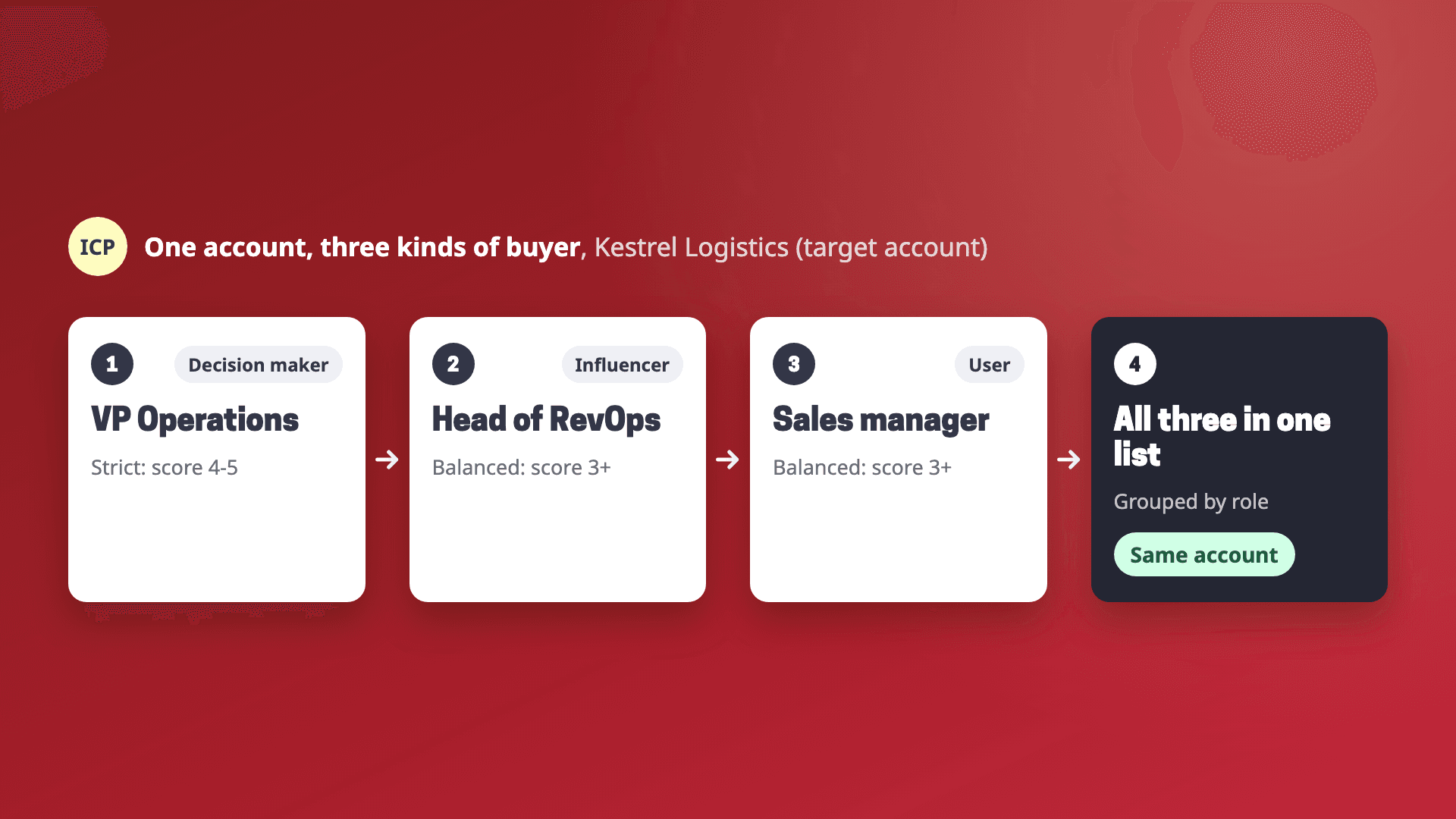
Short answer: Usually no. Your ICP (ideal customer profile) should answer one question: is this person a fit or not? What most teams call their "second" or "third" ICP are groups inside the people who already fit, such as decision makers and influencers, or small and large companies. Keep one ICP to qualify, write the role rules by company size inside it, then split qualified people into groups with their own follow-up. Teamfluence scores everyone who engages with your LinkedIn activity against one ICP, and you tag and route the groups after.
Last updated: 18 Nov 2026
On a call in October, the marketing lead at a healthcare software company described who they sell to. It wasn't one job title:
"the ICP isn't one defined role... I don't want it to be binary."
At large hospitals the buyer is a chief officer. Below them are directors and managers who influence the deal. And at some organizations, the person who signs never touches LinkedIn at all:
"Some larger organizations, people at the top don't even engage... no one size fits all ICP."
The natural next step is to write four or five ICPs, one per role. I told them I didn't want us to go there. My words on the call: "What I don't want us to fall into is multiple ICP profiles... that can get messy."
What is an ICP supposed to do?
An ICP describes the people and companies you want to sell to. In practice, it has one job: decide whether a person qualifies.
Steven, our CEO, explained it to the team in September. When customers ask for multiple ICPs, what they usually want is groups inside the qualified people. The ICP answers yes or no. Everything after that is segmentation.
If you mix the two, you get a list where the same person can fit one ICP and fail another. Then nobody knows if they are a lead.
Why do teams end up with three or four ICPs?
Because their buyer looks different depending on the company.
During an onboarding call, a consulting firm that sells to nonprofits described their buyer like this: at organizations under $10M in revenue, it's the CEO or founder. Above $10M, it's a VP or director. Our onboarding lead suggested two profiles. They kept one, and called it "a puzzle".
It is a puzzle, and the answer is to put both shapes in one ICP as rules:
- Company under $10M revenue: CEO, founder, executive director, president.
- Company over $10M revenue: VP or director of the relevant function.
What you shouldn't do is write one vague description that blends the two, like "senior leaders at nonprofits". A CEO at a small nonprofit and a VP at a large one both fit, but for different reasons. Spell out which title counts at which size.
One ICP or several: what's the difference in practice?
| Several ICPs | One ICP with groups | |
|---|---|---|
| Who qualifies | Depends on which ICP you check | One yes or no for everyone |
| Same person, two profiles | Can pass one and fail the other | Can't happen |
| Adding a new buyer type | Write and maintain another profile | Add a rule or a group |
| Follow-up | Hard to tell which profile triggered it | Each group gets its own workflow |
| Reporting | Leads counted in several places | One count of qualified people, split by group |
How should you rank roles inside one ICP?
Give each role a score instead of a yes or no.
The healthcare marketing lead said something I come back to often:
"I'd rather track all the five out of fives who probably post less... than some patient engagement person on the front lines who might post a lot because she's trying to get promoted, but it's not the decision maker."
On LinkedIn, the people who post and engage the most are often not the buyers. Decision makers tend to read quietly. A front-line employee who comments every day will fill your list and your Slack channel. If your ICP treats every role the same, the loud people bury the quiet ones.
So inside the ICP, map each role to a level. In our call we wrote it as a role hierarchy: the decision makers at the top, then the people who influence the decision, then the people who use the product. A decision maker who visits your profile once is worth more than a front-line poster who likes every post.
More on scoring engagers: how to qualify people who like your LinkedIn posts.
How do you split qualified people into groups?
Once someone qualifies, give them a group and a next step. A setup that works:
- One ICP description with your role rules by company size and a clear list of who doesn't fit (competitors, existing customers, students, whatever doesn't apply to you).
- A score for every person who engages, from 1 to 5, against that ICP.
- Groups by level. Decision makers, influencers, users. Or small and large companies. Use tags.
- One workflow per group. Decision makers might go to the account owner with a note. Influencers might get a connection request from someone on the team. Users might go into a nurture list.
- Target accounts on top. If you have an account list, use it as an extra filter. A person at a target account is worth a look even if their title is borderline.
For the first few weeks, look only at the people who match your ICP. Our onboarding lead's advice is to start with a balanced setting, keeping the people who score 4 or 5, and tighten to 5s only if the list gets too long.
How does Teamfluence handle one ICP?
Teamfluence collects the people who engage with your LinkedIn activity: likes, comments, profile visitors, followers of your profile and company page, new connections and people who engage with your ads.
An AI agent scores each person from 1 to 5 against your ICP and gives a one-line reason. You can also qualify by hand or against a target account list. Then you tag people, set workflows by tag, and send each group to HubSpot, Salesforce, Slack, a CSV, a webhook, the API or MCP.
It doesn't send email sequences. Your team decides how to follow up with each group.
You pay for leads, not seats (pricing).
FAQ
Is it ever right to have two ICPs?
If you sell two different products to two different markets, with different teams, maybe. If it's one product and the buyer's title changes with company size, keep one ICP and write the size rules into it.
What's the difference between an ICP and a buyer persona?
Your ICP decides who qualifies. Personas describe the different people inside the qualified group, so you can talk to each one differently. In the setup above, personas are your groups.
How detailed should an ICP description be?
Specific enough that two people on your team would score the same lead the same way. Name the titles, the company size, the industry and who to exclude.
Should I only follow up with 5 out of 5 leads?
Start with 4s and 5s for the first few weeks so you see enough people. If your team can't keep up, move to 5s only.
What if the decision maker never engages on LinkedIn?
Track the people around them. An influencer at the same company engaging with your posts tells you the account is paying attention. That's where a target account list helps.
Set up one ICP that works
If you want to see how one ICP scores the people already engaging with your team on LinkedIn, we can walk you through it on your own data. Talk to Sales.