

Someone visits your profile on a Tuesday. They read two of your posts. They follow your company page. The next morning they comment on something your founder wrote.
In any other channel, that sequence would set off alarms. A prospect doing that on your website would light up your CRM, trigger a workflow, maybe ping a rep in Slack. On linkedin, it does nothing. It lands in a notification feed, gets scrolled past, and disappears by lunch.
That person just told you they're interested. Loudly. Four times in two days. And your stack never heard a word of it.
This is the strange thing about linkedin. It's the best buying-signal database in b2b. It's also the only one you can't query.
Why linkedin is the best signal database in b2b
Most of the data your team runs on is static. You buy a list. It tells you a company exists, how big it is, what it sells, maybe what's in its tech stack. Useful for building a target list. Useless for timing, because it describes a company. It doesn't tell you that company is paying attention to you this week.
A linkedin signal is the opposite kind of data. When someone visits your profile after reading your post, that's a live act of attention from a named person at a specific moment. When they comment, they're raising a hand in public. That's not a description of a buyer. That's a buyer mid-motion, telling you the timing is now.
Here's the difference laid out plainly.
| Bought contact data | linkedin signals | |
|---|---|---|
| What it is | who a company is | what a person is doing right now |
| Freshness | compiled months ago | real time |
| Intent | none, it's a description | live attention |
| Exclusivity | everyone buys the same list | generated by your own presence |
The column on the right is the data every GTM team says it wants. Intent, fresh, and yours. It already exists, for free, produced by the content and presence your team is already putting out.
So why is almost nobody using it?
The catch: linkedin intent is read-only
Because you can see it, but you can't use it.
Call it read-only intent. The signal is right there in the interface, scrolling past in your notifications. What you can't do is query it. You can't pull "everyone from a target account who engaged with us this week" into Clay. You can't hand it to Claude to draft a follow-up. You can't drop it into your CRM the way you would any other data source and build a workflow on top of it.
Look at everything else your stack touches. All of it is queryable. The one source that shows live intent is the one you have to read with your eyes.
| Data source | Can your stack actually use it? |
|---|---|
| CRM records | yes |
| Product analytics | yes |
| Website visits | yes |
| Email opens and clicks | yes |
| linkedin engagement | no, read-only in the feed |
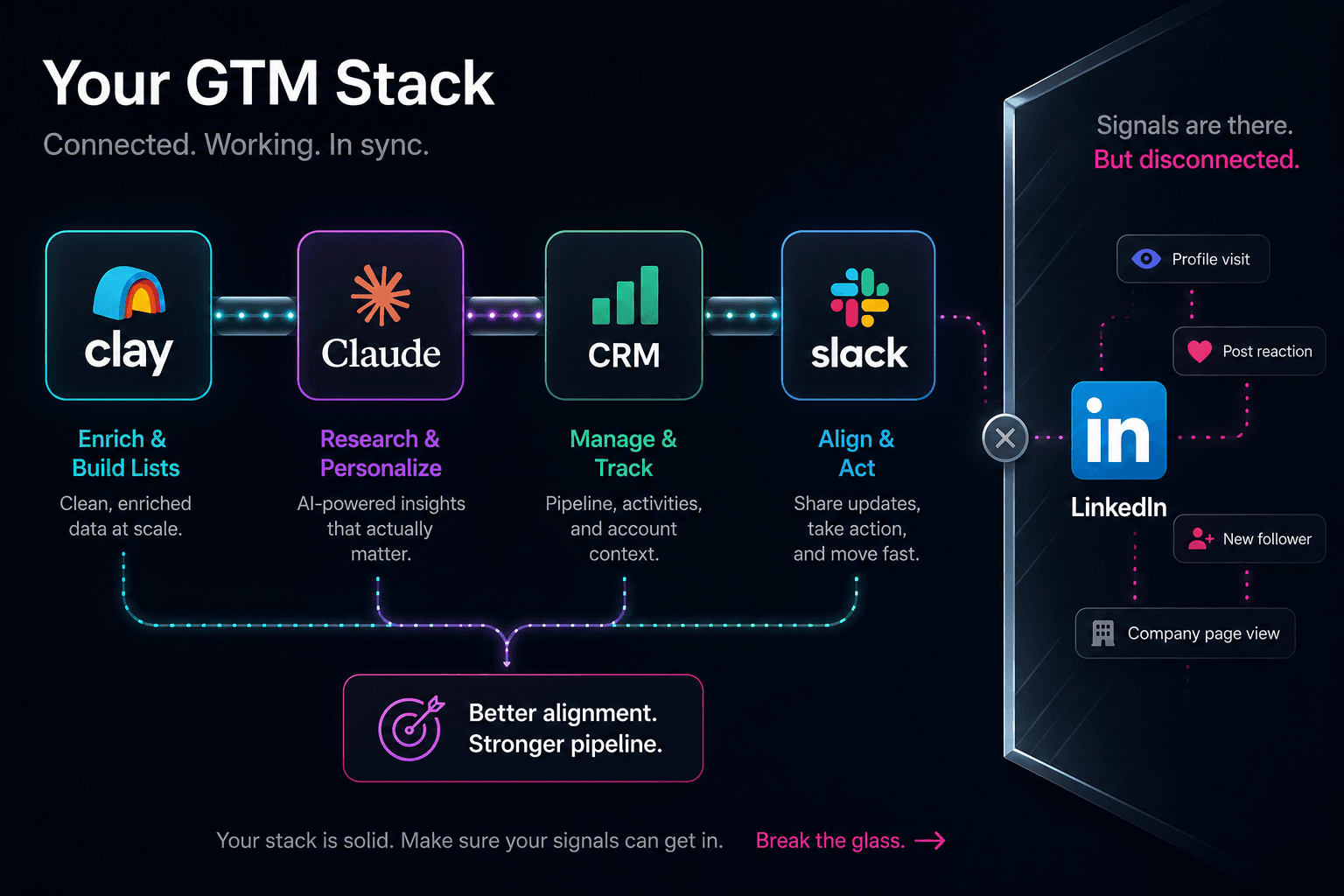
This is the gap. The richest intent signal in b2b sits in a feed, and a stack built to act on data can't reach it. Everything is wired together except the one input that would tell you who to act on first.
What teams do with read-only intent today
Two options. Both lose.
Option one: ignore it. Treat linkedin as a branding channel. Post, watch the likes roll in, report the engagement rate, and never connect any of it to pipeline. Most teams are here. They're sitting on live intent and filing it under vanity metrics.
Option two: work it by hand. A rep notices a good comment, copies the name into a sheet, looks the person up, maybe adds them to a sequence. It works for about five people a week. Then the volume buries them and they stop.
Here's why by-hand is worse than it looks. On linkedin, you usually get one shot.
45.6% of ICP-matched leads engage with you exactly once. One profile visit. One comment. One follow. Then nothing.
Almost half of your best-fit people give you a single moment of attention and never come back. So the window isn't days long, waiting for a rep to notice. If your process depends on a human eventually spotting a signal in a feed, you've already missed nearly half the people worth catching, before anyone has done anything wrong. Nobody made a bad call. The system just couldn't move fast enough, because the signal never left the feed.
The real cost of the access gap
We've measured this across 299,690 signals, 152 workspaces, and 352,061 leads. The pattern is consistent everywhere we look. Teams generate real, ICP-matched intent on linkedin constantly, and most of it never reaches the systems where the work happens.
Now think about what that does in an AI-driven stack. The whole promise of Clay, Claude, and the rest is speed: enrich, score, and act automatically. But they can only act on data they can reach. So they run at full speed on bought, static lists, while the warm signal, the person actually raising a hand, sits in a notification tab and decays.
You end up automating outreach to people who don't know you, and ignoring the people who just told you they do. That's the access gap, and it gets more expensive the more of your stack you automate.
(There's a second problem here too: most of what's in that feed is noise, not signal. That's real, and it's a separate fight. We'll get to it next. But noise you can filter. A signal you can't reach is just gone.)
The shift: treat linkedin as a data source, not a feed
The teams pulling ahead made one change in how they think. They stopped treating linkedin as a place to scroll and started treating it as a data source that feeds the rest of their stack.
Same signals everyone else is ignoring. The difference is they made them usable, so the engagement lands where decisions get made instead of dying in a feed. Not more posting. Not better content. Just closing the distance between where the signal shows up and where you can act on it.
That's the move. And it's mostly an access problem, not an effort problem.
Where this goes
This is the layer teamfluence works in: making the linkedin signal usable inside the tools you already work in, instead of leaving it stuck in the feed.
That's the whole idea. The signal was never the problem. Access was.
The takeaway
linkedin is the richest live-intent database in b2b, and the only one your stack can't query. Every profile visit and comment is a person showing interest in real time, and almost half of them only show it once. The teams that win aren't the ones with the most engagement. They're the ones who can actually use it.
Want the full picture of what your team's linkedin engagement is worth? Get the linkedin signals benchmark report for the complete data, and how much of your engagement is real, usable intent.
Next: most of that signal is noise. Here's how to tell the 16% that matters from the rest.