

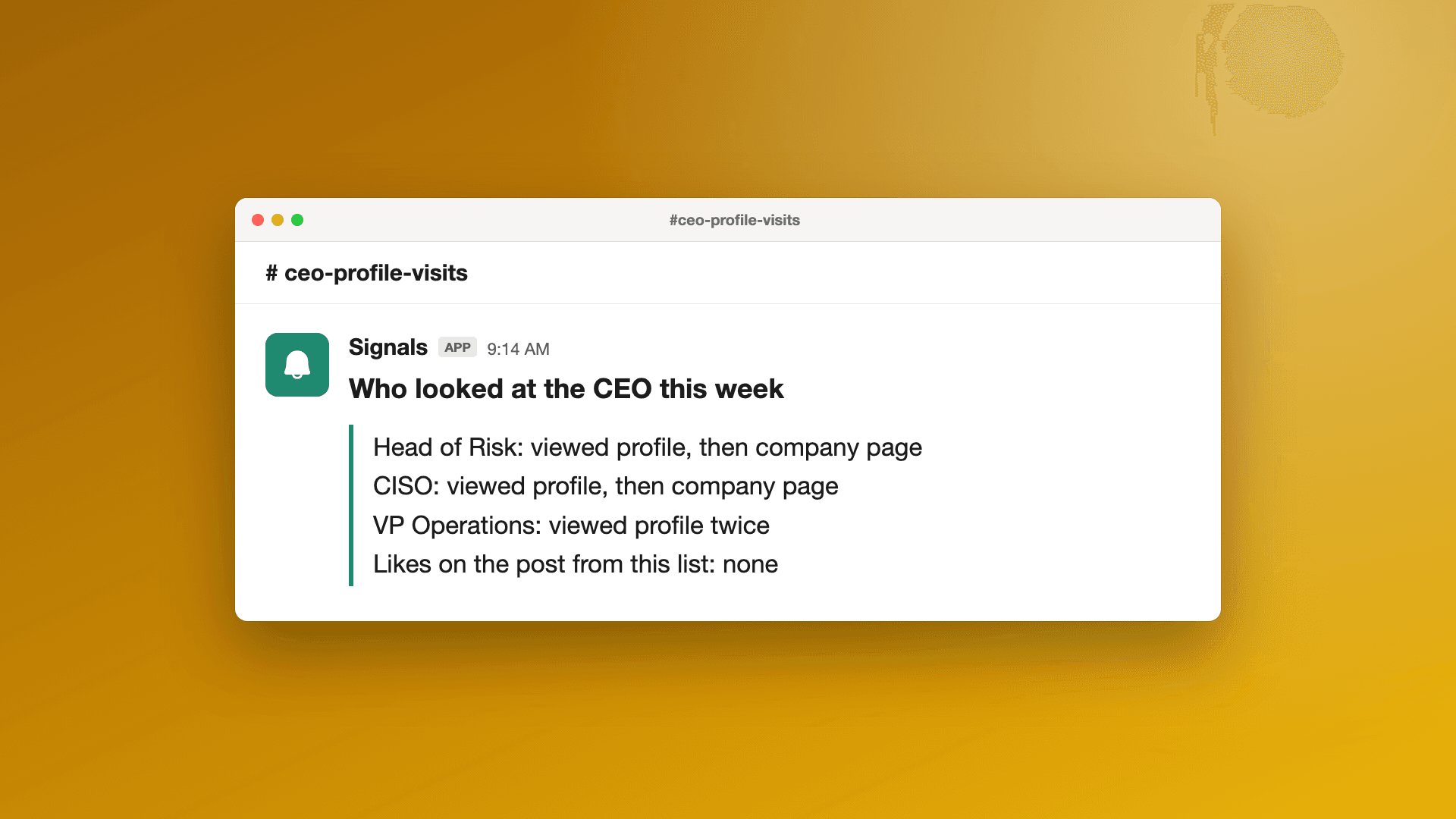
Short answer: Many B2B buyers use LinkedIn under their real name and treat their profile like a CV. A like is public, so a banker, a CISO or anyone in a regulated or careful industry often won't click it. They read the post, open your CEO's profile, check the company page, maybe follow or accept a connection, and leave no trace on the post. If you only count likes and comments, you miss them. Look at profile visitors, followers and new connections across the whole team, qualify them against your ICP, and follow up on what they actually did. Teamfluence collects those signals for every person on the team.
Last updated: 20 Nov 2026
In October we had a sales call with the go-to-market lead of a fintech company. Their buyers are banks. Their executives post on LinkedIn, and the posts get very few reactions. They were starting to wonder if anyone was reading.
Steven, our CEO, was on the call too. He explained what he sees with buyers like theirs:
"Most people are not marketers. They think LinkedIn is a place where they have their digital CV, and if they like the wrong thing they will never get a job again... a banker sees a post, is afraid to like it for compliance reasons or peer pressure, but he will totally check out your CEO's profile."
The go-to-market lead agreed. Their buyers read. They just don't react.
Why don't B2B buyers like or comment on posts?
On LinkedIn people use their real name, their real job and their real employer. I usually say that LinkedIn is treated as a digital CV. Everything you like shows up next to that CV, for your boss, your peers and your next employer.
So people are careful. Steven puts it more strongly on almost every call: most users think of LinkedIn as a job portal, and they're afraid that one like on the wrong post will cost them.
For some buyers there's a second reason. An executive in enterprise cybersecurity told us how security leaders behave online:
"They are dead silent."
He described the reason as vendor fatigue. The moment a security leader shows interest in public, vendors pile in. So they don't show interest in public.
Bankers and CISOs have different reasons. The behavior is the same: they read and they don't react.
What do silent buyers do instead?
They still look. According to Steven, a typical buyer reads your post on their phone at lunch, then opens the author's profile, then opens the company page. Some follow. Some accept a connection request later. None of that shows up as a like on the post.
On a call earlier this month Steven guessed that when you post, "maybe 5%" of the people who see it like or comment. He called it a guess. It matches what we hear on calls: most of the audience never touches the post.
Steven's conclusion from this:
"the precursor for meetings are profile visits, profile followers, company profile visits."
He also has a simple way to explain why a profile visit is a stronger signal than a like on someone else's post: "People who visit your profile know who you are."
Which signals tell you a buyer is interested?
| Signal | Visible to the buyer's network? | What it usually means | How to follow up |
|---|---|---|---|
| Like on a post | Yes | They saw it and agreed enough to click | Thank them, ask about the topic |
| Comment | Yes | They want to be seen in the conversation | Reply in the thread first |
| Profile visit | No, only to the profile owner | They wanted to know who wrote it | Visit back, then a short note |
| Follow (person or company page) | Less visible than a like | They want to see more | Connect, offer something useful |
| Accepted connection request | No | They're open to hearing from you | A networking message, no pitch |
| Company page visit | No | They're checking out the company | Pass it to the account owner |
The quiet signals at the bottom of the table are where silent buyers show up. Most buyers engage silently: they read, visit, follow, and never comment.
What does LinkedIn show you about who viewed your profile?
On a free account you see the three most recent viewers from the last 90 days. With Premium you get the full list of viewers for up to 365 days (LinkedIn Help: who viewed your profile, checked 10 Nov 2026).
That's why the cybersecurity executive keeps paying for Premium. On our call he said:
"That's the only reason I pay the 30 bucks a month"
The catch for a company is that this view belongs to each person. Your CEO sees their own viewers. Your head of sales sees theirs. Nobody sees the whole team's list in one place, and nobody checks it against your ICP. We wrote about a simple Monday routine for this in how to see who viewed your sales team's LinkedIn profiles, and about what a profile view does and doesn't tell you in reading LinkedIn profile views.
How do you follow up on a profile view without being creepy?
- Qualify first. Most profile visitors are recruiters, old colleagues and people selling to you. Keep the ones who fit your ICP or work at a target account.
- Reach out from the person they visited. If they looked at your CEO, the message comes from your CEO. They already know that name.
- Mention what they did, lightly. Steven's opener is: "Hey, saw that you checked out my profile, so I checked out yours. What is it that your company does?" It's honest, and it asks about them.
- Don't pitch in the first message. Ask a question, share something useful, wait.
- Give the account to sales. If several people from the same company visit different profiles on your team, that account is warmer than any single like.
Should your CEO's profile work like a landing page?
If buyers skip the post and go to the profile, the profile does the selling. Steven tells executives to treat it like a landing page, with a clear next step and something useful to download. In practice that means a headline that says who you help, an About section written for the buyer, and a featured link to a guide.
The order matters too. When your CEO sends a connection request, the other person usually looks at the profile and the company page before accepting. After they accept, your CEO's next posts start showing up in their feed. The profile is the step in the middle, and it's the one most executives never update.
How does Teamfluence help you see silent buyers?
Teamfluence collects the people who engage with your team on LinkedIn, including the quiet signals: profile visitors, followers of personal profiles and the company page, and new connections, next to likes, comments and ad engagers. It does this for every person on the team at once, so your CEO's visitors and your AEs' visitors land in one list. Seats are unlimited.
You qualify each person by hand, with an AI agent that scores them 1 to 5 against your ICP with a one-line reason, or by matching them to your target accounts. Then you send them to your CRM, a CSV, Slack, a webhook, the API or MCP, with what they did and when. That's your opening line.
You pay for leads, not seats. See pricing.
What it doesn't do: it doesn't write the message for you and it doesn't send sequences. The follow-up stays human.
FAQ
Why do people view my LinkedIn profile but not like my posts?
A like is public and sits next to their name and job. A profile view is only visible to you. Careful buyers, especially in regulated industries, prefer the quiet option.
Is a profile view a buying signal?
On its own, it means someone wanted to know who you are. It becomes a signal when the person fits your ICP, works at a target account or does something else soon after, like following your company page or accepting a connection.
How many profile viewers can I see on LinkedIn for free?
The three most recent viewers from the last 90 days. Premium shows the full list for up to 365 days (LinkedIn Help a548046, checked 10 Nov 2026).
Should I message everyone who views my profile?
No. Qualify first and only follow up with people who fit your ICP. Use the opener above and ask about them.
What should I measure instead of likes?
Count the qualified people who engaged in any way, including profile visits, follows and accepted connections, per post and per person on the team. See how to measure ROI on founder-led content.
See the buyers who never click like
If your executives post and the reactions are quiet, we can show you who's reading anyway. Talk to us.