

Short answer: Measure founder-led content by who it reaches, by name. Each month, count the people from your ICP and your target accounts who liked, commented, visited the founder's profile or connected, then follow them into conversations, pipeline and closed deals. ROI is the revenue from deals where someone at the account engaged before the first meeting, minus what the content cost, divided by that cost. Impressions and likes mostly measure the founder's existing network. If that network is friends and ex-colleagues, fill it with ICP contacts first, then boost the best posts as thought leader ads to ICP people outside it.
Last updated: 5 November 2026
The founder of a two-person B2B agency told us on a call: "I started posting three months ago constantly on LinkedIn. And I get one client and two meetings, but I'm having posts with 100,000 views, 50,000 views, 20,000 views and stuff."
All those views turned into one client. That gap is why the ROI question is hard for founders. The numbers LinkedIn gives you are about reach. The numbers that pay for the founder's time are about a handful of named people at companies you want to sell to.
This guide covers what to count, a worked example of the math, and two fixes for when the founder's audience is the wrong one.
Why don't impressions and likes show the ROI of founder content?
A founder's network is built over a career. Friends, ex-colleagues, people from old jobs, investors, other founders, people who sell to you. They like the founder's posts because they know the founder. That's fine, and it's most of the like count.
On a recent sales call, a software company described exactly this. Their founders post regularly, and most of the engagement comes from friends and former colleagues. The posts do well. Nobody could say whether a buyer had seen them.
LinkedIn's own post analytics help a little. On desktop they split reach into "In network" and "Out of network", and they add post viewer demographics (the breakdowns are kept for 180 days). That tells you whether a post traveled past people who already know the founder, and roughly which job titles saw it. It doesn't tell you who.
Profile views have the same limit. A free account shows the three most recent viewers from the last 90 days. Premium shows the full list for up to 365 days (LinkedIn Help). That's useful for one founder checking their own week. None of it reaches your CRM.
What should you measure instead?
Named people who match. Four counts, every month:
- ICP people who engaged. Anyone who fits your ideal customer (title, seniority, company size, industry) and liked, commented, visited the founder's profile, followed or connected. Count people, not reactions. Someone who liked three posts is one person.
- Target-account people who engaged. If you sell to a named list of accounts, anyone from those companies counts, whatever their title.
- Conversations started. Replies, calls booked or intros with someone from the first two lists.
- Pipeline and revenue touched. Deals where someone at the account engaged with the founder before the first meeting.
The first two are leading signals: you see them within days of a post. The last two take as long as your sales cycle.
Two rules keep the numbers honest. Take out employees, customers, competitors and recruiters before you count. And write down the date of each engagement, because "engaged before the first meeting" is what makes a deal content-touched.
To decide who fits, use the 1 to 5 score in how to qualify people who like your LinkedIn posts. For which actions count most, see LinkedIn engagement signals, ranked.
Which founder content metrics are vanity, and which show pipeline?
| Metric | What it tells you | The catch for founder content | Count it? |
|---|---|---|---|
| Impressions | How often the post was shown | Mostly the founder's existing network | As context only |
| Likes and reactions | How many people reacted | A like from a buyer looks the same as a like from an old classmate | No |
| Follower count | Audience size | Grows with anyone, including people you'll never sell to | No |
| Comment count | How much discussion | Peers and other founders comment most | Read the comments, skip the count |
| Profile views (total) | Interest in the founder | A total with three names on a free account | Only with names |
| ICP people who engaged | Buyers noticed the post | Needs names and a fit check | Yes, monthly |
| Target-account people who engaged | Your accounts are paying attention | Needs a target account list | Yes, monthly |
| New ICP connections | The founder's audience is getting more relevant | Count requests sent and received | Yes, monthly |
| Conversations started | Signals turned into talks | Needs someone to follow up | Yes, monthly |
| Pipeline touched | Deals where the account engaged before the first meeting | Takes a sales cycle to show | Yes, quarterly |
| Revenue closed | The return itself | Slowest to show, and every deal has more than one touch | Yes, for the ROI number |
How do you calculate the ROI of founder-led content?
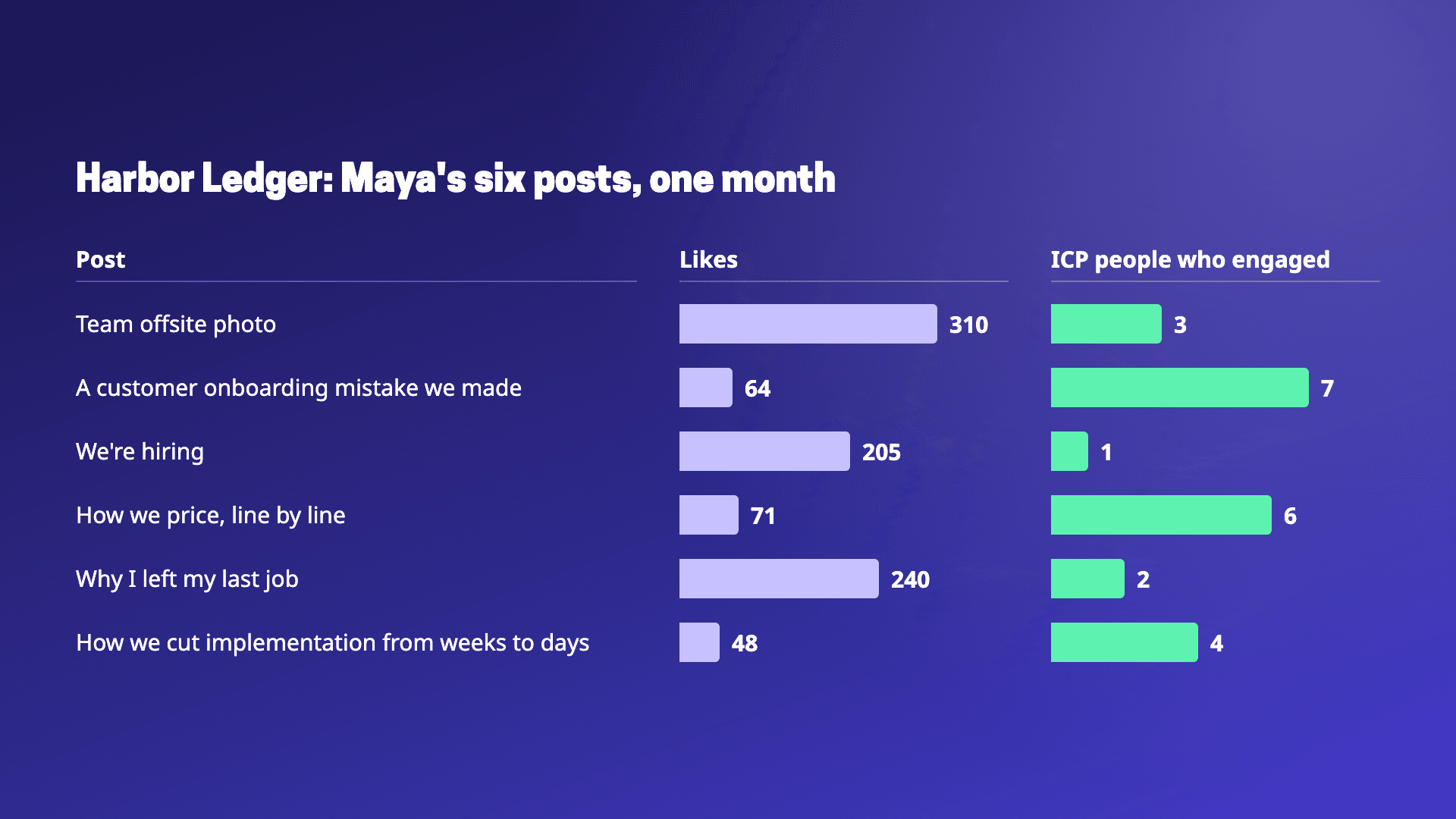
Here's a worked example with a made-up company. Harbor Ledger is a fictional 25-person software company. Its founder, Maya, posts six times in one month. This is the sheet:
| Post | Impressions | Likes | ICP people who engaged | From target accounts |
|---|---|---|---|---|
| Team offsite photo | 14,200 | 310 | 3 | 0 |
| A customer onboarding mistake we made | 3,900 | 64 | 7 | 3 |
| We're hiring | 9,800 | 205 | 1 | 0 |
| How we price, line by line | 4,600 | 71 | 6 | 3 |
| Why I left my last job | 11,300 | 240 | 2 | 0 |
| How we cut implementation from weeks to days | 3,100 | 48 | 4 | 3 |
| Total | 46,900 | 938 | 23 | 9 |
The three most-liked posts brought 6 of the 23 ICP people and nobody from a target account. The three posts about the work brought 17, including all 9 from target accounts.
Then the month plays out in the example:
- Maya and sales follow up with the 23 ICP people. Six of them reply and talk.
- Two of those talks become opportunities, worth €30,000 in pipeline.
- Three months later, one closes at €15,000.
The month cost €2,500 for an editor and a small boost budget, plus about six hours of Maya's time.
The math:
- Pipeline to cost: €30,000 divided by €2,500 is 12 to 1. That's your early read, before anything closes.
- ROI on closed revenue: (€15,000 minus €2,500) divided by €2,500 is 5, or 500%.
If you can't put a price on the founder's hours, leave them out and say so in the report. If the founder asks whether posting is worth their week, put a price on them.
Two choices change the answer, so decide them before you start:
- Sourced or touched. "Sourced" means the content started the conversation. "Touched" means someone at the account engaged before the first meeting. Every sourced deal is also touched, so touched is always the bigger number. Report both.
- The window. Count engagement in the 90 days before the first meeting, or whatever matches your sales cycle. Pick one and keep it.
Add one more source: a free-text "How did you hear about us?" field on your demo form. Founders get named there, and it catches people who read every post without ever clicking like.
What if the founder's network is mostly friends and ex-colleagues?
Fix the audience before you judge the content. If most of the people who see a post know the founder from an old job, a good post about your buyer's problem still lands in front of the wrong people.
- Connect with ICP people first. Every week, the founder sends connection requests to people at target accounts and people who fit your ICP. Add a short note when there's a real reason, like a shared customer or a post of theirs.
- Accept the right requests. ICP people who ask to connect after a post are a signal on their own. Count them.
- Watch the ICP column. As the network fills with buyers, the same kind of post reaches more of them. The monthly count of ICP people who engaged is how you'll see it.
This is the slow fix. It takes months, and until the network changes, expect low ICP counts even on good posts.
Should you boost the founder's best posts as thought leader ads?
Once you know which posts pull in ICP people, it's worth testing. LinkedIn's thought leader ads let a company promote a post from an employee's profile, such as the founder's, once the author approves the request. LinkedIn lists brand awareness, engagement and video views as the objectives.
Pick the post by the ICP column. In the example above, that's the onboarding-mistake post (7 ICP people, 3 from target accounts). The offsite photo had almost five times the likes and three ICP people.
Then aim it at people outside the founder's network. LinkedIn's matched audiences include company targeting for account-based campaigns and contact targeting from a list you upload. Your target account list is the obvious audience.
Measure the boost like any other post: count the ICP people who engaged with the ad, and put the ad spend in the cost line of your ROI.
How is this different from measuring a whole team's LinkedIn ROI?
The method is the same. With one founder, the problem is usually the audience: a network built over a career. With a team of sellers, it's coverage and follow-up speed across many profiles. For team metrics like ICP match rate, time to follow-up and account coverage, read how to measure social selling ROI.
If the founder and the team both post, count them in one list. A buyer who likes the founder's post and then visits a sales rep's profile is one person paying attention to your company.
How does Teamfluence measure founder-led content?
Teamfluence collects the people behind the numbers: likes, comments, profile visitors, followers, new connections and people who engage with your thought leader ads, across the founder's profile, the team's profiles and the company page.
Each person is then qualified one of three ways. An AI agent scores them 1 to 5 against your ICP and writes one line on why. Or you upload your target accounts, and anyone from those companies counts. Or you review by hand.
Qualified people go to HubSpot, Salesforce, Slack, a webhook or a CSV, each with what they did and when. That date is what the touched-pipeline count needs. Step by step for HubSpot: HubSpot LinkedIn integration.
FAQ
How long does founder-led content take to show ROI? The ICP counts show up within days of each post. Pipeline and revenue take as long as your sales cycle. Judge the content on ICP engagement every month and on pipeline every quarter.
What's a good number of ICP people per post? We don't know of a benchmark worth quoting. Compare the founder against their own last three months, and compare topics against each other. If you sell to a target account list, track the share of engagers from those accounts too (more on ICP match rate).
Should the founder stop posting personal stories? No. Personal posts keep the founder familiar to people who already know them, and some of those people refer buyers. Count their likes for what they are, and check the ICP column for each type of post.
What about buyers who read but never engage? Most buyers read, visit a profile or follow without commenting. Profile visits and follows catch some of them. The "How did you hear about us?" field catches more. Some you'll never see, so treat your ROI number as a floor.
Who should own the measurement? Marketing, or whoever writes the monthly report. The founder gets one short update a month: which ICP people and target accounts engaged, and what came of it.
See it on your founder's posts
If your founder posts and you want to see which buyers engage, by name, with the dates your ROI report needs: talk to sales and we'll show it on your own team's data.
Related: How to measure social selling ROI · How to qualify people who like your LinkedIn posts · LinkedIn engagement signals, ranked