

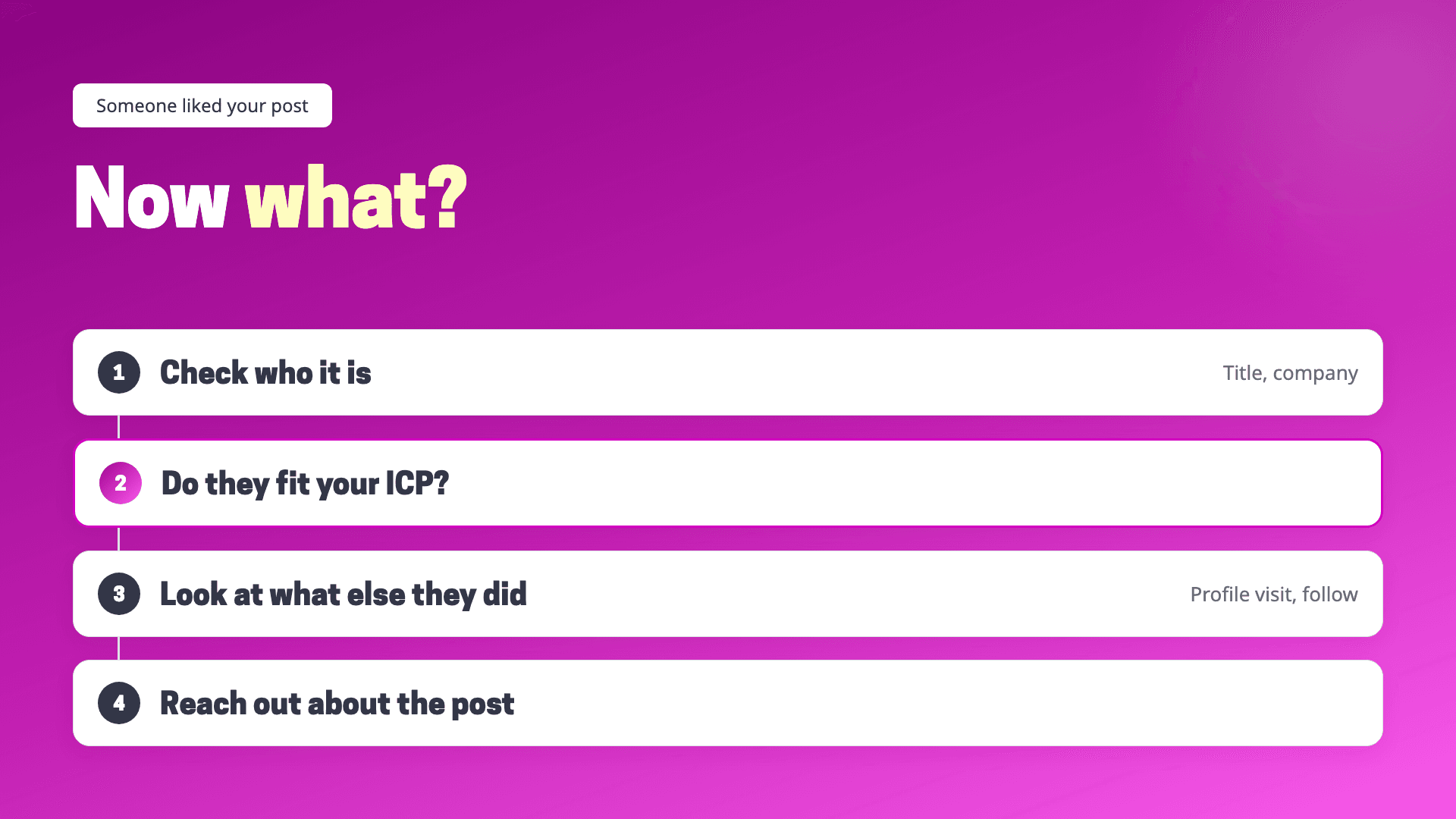
Short answer: A like tells you someone is interested in the topic of your post. It's early: closer to a marketing lead than a sales lead. Check if the person fits your ICP. If they do, send one short message that thanks them and asks what they do, with no pitch. Then wait until they ask about your work before you offer anything. One follow-up at most. Teamfluence collects the people who like your team's posts, scores each one against your ICP, and sends the good fits to your CRM or Slack so the right person can say hi.
Last updated: 25 November 2026
Our CEO, Steven Morell, explains the first message after a like with a picture from conferences. He said this on a call with a founder who wanted more meetings from LinkedIn:
"Think of LinkedIn as the conference hotel where your target group is having their annual convention. You're in the hallway track. Somebody's coming out of a keynote. What you say is, Hi, I'm Nico. Enjoying the conference? How did you like the keynote? The keynote is the post."
Nobody walks out of a keynote and hands a stranger a proposal. The same rules apply in the DMs. This post covers what a like tells you, who deserves a message, what to write, when to offer something, and when to stop.
What does a like on LinkedIn tell you?
It tells you the person read at least part of your post and agreed with it, or liked the topic enough to tap. It doesn't tell you they have a project, a budget, or any interest in buying from you.
That puts a like in the nurture stage. In sales terms, it's closer to a marketing qualified lead (someone who showed interest in your content) than a sales lead (someone who asked to talk). If you treat it like a demo request, you'll send a pitch to someone who only wanted to read a post.
It's also a rare signal. On the same call, Steven said: "99% of people never like and never comment anything. What they do is they look at your profile." The people who do like are the visible part of a larger, quieter audience. Profile visits, follows and connection requests often say more. See how to read LinkedIn profile views and LinkedIn engagement signals, ranked.
Should you message everyone who liked your post?
No. Most people who like your posts are colleagues, peers, friends, recruiters and people who will never buy from you. Messaging all of them wastes your time and theirs.
Check fit first: job title, company, industry, and whether the company is on your target account list. A marketing lead at a B2B software company put it plainly on a call with us: she didn't want to follow up with someone who's "commenting on her summer vacation post."
The fuller method for sorting likers is in how to qualify people who like your LinkedIn posts.
What should the first message say?
Use the hallway test. Before you send it, ask: would I say this to someone I just met outside a conference room?
Steven gave a version that fails the test: "Hey, thanks for liking my post, do you want a free audit? That's pretty aggressive."
And one that passes. He wrote it for a profile visit, and it works for a like too: "Thanks for visiting my profile. I checked out yours and your website. What is it that you do?"
For a like, swap the first line for the topic of the post. Something like: "Thanks for the like on my post about first-party data. I had a look at your company. What does your team focus on?"
What makes it work:
- It's short enough to answer from a phone.
- It asks about them. Nothing about your product.
- It mentions the topic, so they know why you're writing.
- It has no link, no calendar, no PDF.
Some people will answer and some won't. Both are fine. As Steven put it: "Ask a question. Don't be salesy. And then at some point they will return the favor."
If you're not connected yet, send a connection request with a short note about the post's topic. Same rules: no pitch in the note.
When should you offer something?
When they ask. Steven's motto for this is "thanks for asking, let me tell you." You've earned the right to talk about your work once they've asked what you do. Before that, any offer reads as the pitch you were trying to avoid.
If they reply and the conversation stalls, don't rush it. Steven's advice on the same call: "Some will respond, some not. And then just wait. Wait two weeks and then open a conversation."
Opening a conversation can mean sharing something useful that fits what they told you, like a guide, a checklist, or a post you wrote on their problem. It still doesn't mean a meeting request.
Why so slow? Steven again: "nobody wants to buy from a total stranger because we don't know whether the stranger is acting in their interest or in our interest." Each short exchange, each post they read, each useful thing you send moves you away from stranger.
How many follow-ups is too many?
More than one. If they don't answer your first message, you can send one follow-up later, ideally tied to something new: another post they engaged with, or a question about their reply to someone else. After that, stop and let your content do the work.
The reason is that people can tell when they're in a sequence. On a call with a consultancy, I said it like this: "People already know when they're being targeted by a sequence." The fractional commercial lead on that call described what automated outreach looks like from his side: "you just see the crap."
A founder of a small B2B agency told us cold outbound "didn't even work well three years ago but now it doesn't work at all." An automated sequence that starts with a like is still cold outbound, with a warmer first line.
What if they did more than like your post?
A like on its own is a light signal. Several signals from the same person, close together, are worth more. I described one on that consultancy call: "Three likes, and one of those profiles also checked your profile and sent you a connection request and it matches your ICP. That's the thing that pays."
| What they did | What it tells you | What to do |
|---|---|---|
| Liked your post, doesn't fit your ICP | Interest in the topic | Nothing. Let them keep reading. |
| Liked your post, fits your ICP | Interest in the topic from a possible buyer | Thank them, ask what they do. No pitch. |
| Commented on your post | Interest, and they want to be seen talking about it | Reply in the comments first. A DM can come later. |
| Visited your profile after a post | Curious about you, not only the topic | Thank them for the visit, ask what they do. |
| Followed your company page | Wants to keep hearing from you | Add to your nurture list. Watch for the next signal. |
| Liked, visited your profile and sent a connection request, and fits your ICP | Looking at you as a possible partner | Accept, thank them, ask what they're working on. Tell the account owner. |
Timing still matters once you decide to write. See the 48-hour rule for social selling on LinkedIn.
How does Teamfluence help after a like?
Teamfluence collects the people who like or comment on your team's posts, visit your profiles, follow you or your company page, or send connection requests. Its AI agent scores each person from 1 to 5 against your ICP and gives a one-line reason. You can upload a target account list so people from those accounts stand out.
Good fits go where your team already works: HubSpot, Salesforce, Slack, a CSV, or other tools through webhooks and the API. Your team writes the message. Teamfluence doesn't send messages for you.
- Best for: teams where founders, execs or reps post on LinkedIn and want to know which likers are worth a hello, and who should say it.
- Less suited if: you want a tool that writes and sends automated DM sequences. Teamfluence doesn't do that.
- Price: you pay for leads, not seats. See pricing.
The full path from engagement to a booked meeting, for a whole team, is in how to turn LinkedIn post engagement into leads.
FAQ
Should I mention the like in my message? Mention the topic of the post. That tells them why you're writing. "Thanks for the like" on its own gives them nothing to answer.
Should I send a connection request to people who liked my post? Only to the people who fit your ICP. Add a short note about the post's topic and skip the pitch.
Who should send the message, marketing or sales? The person whose post it was, or the person who owns the account. A message from someone they've just read lands better than one from a stranger on the same team.
What if they reply and ask what I do? Then you've passed the hallway test. Answer in a couple of sentences and ask one question back. Offer a call only if what they describe is a problem you solve.
Is a like enough to add someone to my CRM? If they fit your ICP, add them as an early lead and keep them out of the sales pipeline until they ask to talk. See how to push LinkedIn engagers into your CRM.
Is this slower than cold outreach? Per person, yes. You're only writing to people who already showed interest, though. For the cost side, see warm leads vs cold leads.
See who's worth a hello
If your team posts on LinkedIn and you want to know which likers fit your ICP, routed to the person who should say hi: talk to sales and we'll show it on your own team's data.
Related: How to qualify people who like your LinkedIn posts · How to turn LinkedIn post engagement into leads · LinkedIn engagement signals, ranked